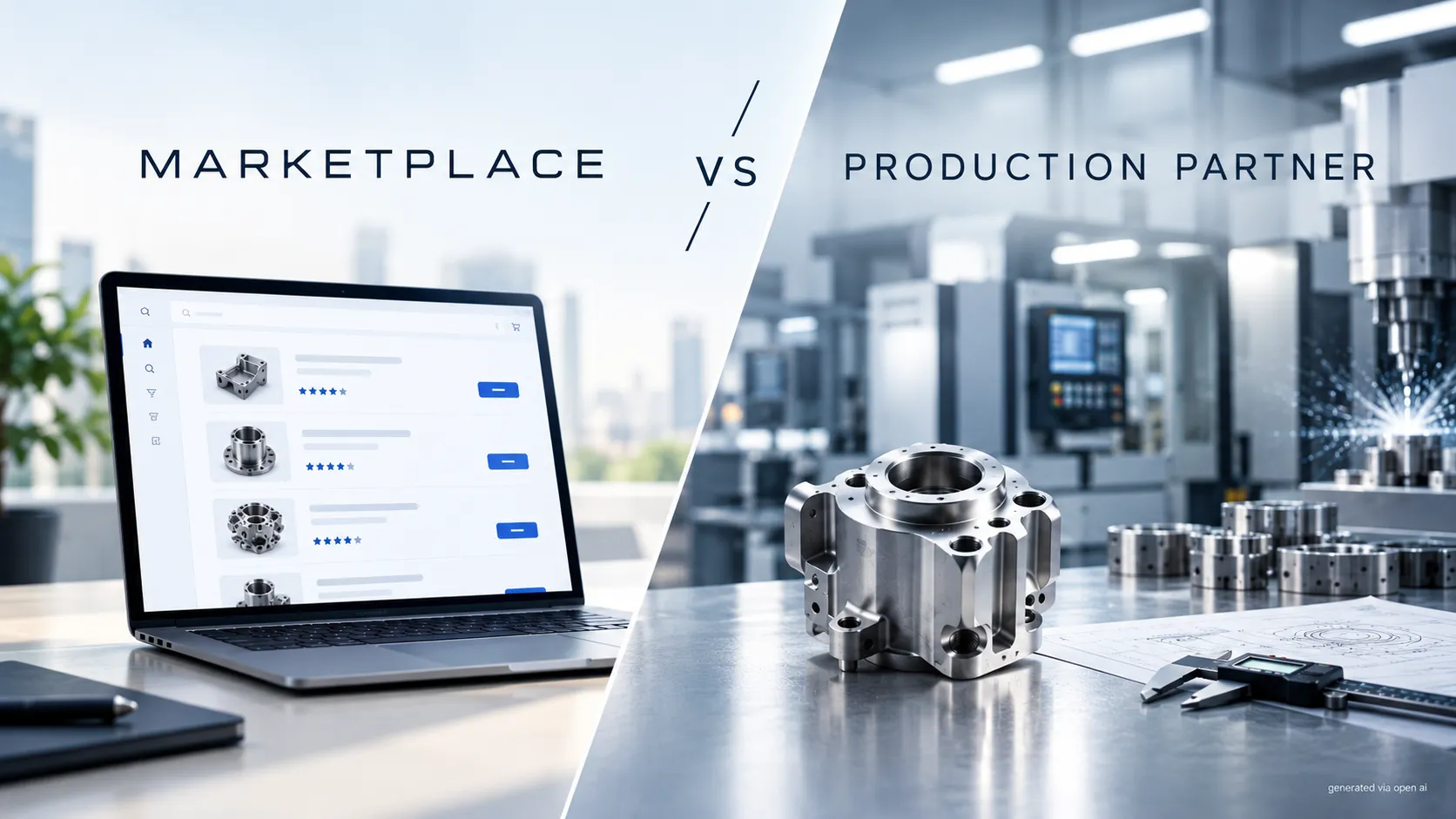
A procurement platform for industrial parts promises to turn weeks of supplier hunting into a single upload. For some requirements, that holds true. For others, going through your established supplier is still the better call. This article explains how these platforms actually work, which costs they genuinely reduce, and where they run out of road — so you can judge before your first project whether the effort pays off.
How a procurement platform for industrial parts works
The term covers more than a quoting page. From enquiry to delivery, four steps interlock — and how far each one is automated varies considerably between providers:
1. Enquiry with technical data
Instead of an email with a drawing attached, you upload a CAD model or a dimensioned drawing along with material, tolerances, surface finish and quantity. The information is captured in a structured form, so it doesn’t have to be explained again to every supplier.
2. Technical review and process selection
This is where providers differ most. Some platforms run on instant-quote calculators: you upload the file, pick the technology and material yourself, and get a price within seconds. That’s convenient, but it comes with two catches. The figure shown is calculated from the geometry and may still change once the manufacturer reviews the part properly. And choosing the process and material is left to whoever submits the enquiry — pick a combination that isn’t technically ideal and you’ll still get a price, just for the weaker solution.
Replique takes a different route: a technical assessment comes before the quote. The review covers whether the part can be made as drawn, which process and material genuinely suit it, and whether the specifications match the actual requirement. It often turns out that a tolerance was carried over from an old production drawing and isn’t functionally necessary, or that a different material would perform the same job and be available sooner. The price then comes directly from the manufacturing partner best suited to that part — so it isn’t an estimate that gets corrected later.
For choosing a provider, this means: for uncritical standard geometries with clean data, a fast instant quote is usually enough. As soon as parts are older, more complex or unclear in their specification, the upfront review earns its keep.
3. Matching a manufacturing partner
The platform selects a partner from its network that covers the process, material, capacity and ideally the region as well. Rather than negotiating with five suppliers, procurement receives one quote and has one point of contact.
4. Order handling and documentation
Ordering, status tracking, inspection reports and invoicing all run through the same channel. That cuts the back-and-forth that would otherwise bounce between engineering, procurement and quality assurance.
The real time saving rarely happens in production. It happens before it — in the days that would otherwise go into finding suppliers, chasing answers and comparing quotes.
Which costs procurement platforms actually reduce
The unit price isn’t always where the leverage sits. Anyone assessing the value of a procurement platform for industrial parts should look at the costs that arise before and after the order itself and never appear on a supplier invoice.
The Supply Chain Management department at HTWK Leipzig measured a procurement transaction down to its individual process steps. For an unstructured, manual workflow, the study puts process costs at roughly 95 euros per transaction; a fully digital process brings that down to around 68 euros. One side finding is worth noting: simply standardising manual workflows achieves very little — only digitalisation moves the number.
A follow-up study by HTWK surveying 181 European procurement leaders in 2025 shows the conditions under which this happens. The focus was indirect procurement — meaning everything a company buys that doesn’t go into the product it sells but keeps operations running: spare parts, consumables, custom-made items. Almost half the companies surveyed manage this area with fewer than five dedicated staff, against spend running into eight figures. With teams that thin, coordination effort determines how many transactions can be handled at all.
Then there are inventory costs. Buying special parts in bulk to meet minimum order quantities ties up capital and carries the risk of write-downs. German calculation examples typically put annual holding costs at 14 to 20 per cent of inventory value; Lokad cites 25 per cent as a common rule of thumb. For slow-moving parts, that adds up substantially over the years.
Specific part, unclear sourcing situation?
Replique assesses feasibility, process and the right manufacturing partner — with no lengthy lead-in.Limitations of a procurement platform for industrial parts
Three issues decide in practice how smoothly the start goes — and they tend to be underestimated beforehand:
Missing or incomplete part data
Without a CAD model, or at least a dimensioned drawing, not much can happen. With older spare parts a model can often be derived from a physical sample, but that is a separate task with its own effort and needs to be planned in. Providers differ sharply here: pure brokerage portals hand the problem back to the customer, whereas a procurement platform for industrial parts such as Replique covers engineering alongside production — from data preparation and design adaptation for the chosen process through to material selection. If you have no in-house design capacity spare for tasks like these, it’s worth factoring into the decision.
Parts requiring formal approval
In regulated fields such as rail, medical technology, aerospace or pressure equipment, it isn’t enough for a part to be made to dimension. The process, material and production site have to be approved for that application, and approval rests on documented evidence rather than price. A cheaper quote is no help if the paperwork for sign-off is missing.
When choosing a platform, the decisive question is therefore whether the network actually includes partners with the relevant certifications — depending on the industry, ISO 9001 as a baseline, IATF 16949 for automotive, EN 9100 for aerospace, ISO 13485 for medical devices or EN 15085 for welding in rail vehicle construction. Equally important is which documents come with the parts: material certificates, first article inspection reports and measurement protocols should be part of the quote, not something to be ordered separately after the fact. This question belongs at the start of a project.
The initial set-up effort
Handing over data, approval processes and, depending on the setup, an ERP connection all take more time on the first project than on the tenth. How high that hurdle is, however, depends heavily on the provider. At Replique, an initial enquiry requires neither an account nor any platform setup: send the drawing or CAD file and the team handles the assessment. Short-notice requirements can be dealt with this way too — deeper integration becomes worthwhile later, once parts are running through the channel regularly.
Which requirements are worth starting with
Procurement platforms for industrial parts don’t suit every item in a parts portfolio equally well. As a rough guide to which requirements fit and which are less suitable:
| Type of requirement | Suitability | Why |
|---|---|---|
| Spare parts with rare, irregular demand | high | No minimum quantity, no stock, no write-down risk |
| Small series with a stable design | high | Repeatable production without own tooling or inventory |
| Short-notice demand after a supplier falls through | high | Enquiry possible with no lead-in, production starts on release |
| Prototypes and design samples | medium | Useful when the process or material isn’t available in-house |
| High-volume production parts | medium | Worth comparing against existing framework agreements |
| Safety-critical parts requiring approval | case by case | Partner certifications and inspection documentation decide |
Replique as a procurement platform for industrial parts
Replique covers the entire process from enquiry to delivery and combines it with a digital warehouse. Parts are stored there as a data set and can be produced at any time to the same quality, without having to build up physical stock. Production runs through a network of more than 450 certified manufacturing partners worldwide, with the right partner selected according to process, capacity and location. There are no minimum order quantities.
Unlike pure brokerage portals, engineering is part of the service: data preparation, design adaptation and material selection are handled by the same team that later coordinates production. The choice of process is deliberately left open — depending on geometry and requirements, 3D printing may be the answer, in other cases CNC machining, casting or injection moulding. Replique itself is certified to ISO 9001 and ISO 27001; manufacturing partners in the network are qualified in advance and work to the industry standards applicable in their field.
What this looks like over several years is illustrated by the work with Alstom: individual components such as door stoppers and tank caps have grown into a global partnership supplying several country organisations.
Not sure whether your parts are a fit?
Send us a few items and we’ll give you a straight assessment, including a process recommendation.FAQ
What is a procurement platform for industrial parts?
A digital solution through which companies submit technical drawings or CAD data and then handle quoting, production and delivery via a single channel — rather than approaching and coordinating individual suppliers separately.
Does a platform replace my existing suppliers?
In most cases, no. It supplements the existing network where flexibility is needed: special parts, prototypes, small series and as a fallback during shortages. For production parts, established suppliers usually remain the better option.
How long does it take from upload to quote?
That depends heavily on how complete the data is. With a CAD model, material and tolerances in place, a response is usually possible within hours to days. If information is missing or a feasibility review is needed, the lead time extends accordingly.
Data, quality and getting started
What happens to my design data?
At Replique the data sits in an end-to-end encrypted digital warehouse. Manufacturing partners receive only the information required for their specific order. Replique is certified to ISO 27001.
How is part quality ensured?
Through pre-qualified, certified manufacturing partners plus defined production parameters and inspection protocols for each process. For critical parts, your own first article inspection is a sensible addition.
What if the CAD data no longer exists?
In many cases a manufacturable model can be derived from a dimensioned drawing or an existing sample part. Providers with in-house engineering take on this step; the effort is one-off and makes the part permanently available in digital form afterwards.
What’s a sensible way to start?
Most simply with a specific enquiry about a single part — at Replique without registering first. For building up a larger parts portfolio, five to ten items with complete data have proven a good starting point, since they give a reliable picture of lead time, quality and handling.