A pump fails, the impeller is damaged, and the supplier tells you the spare part is no longer available. Or they will still make it, but only at a minimum order quantity far beyond what you actually need. For maintenance teams, procurement and OEM aftersales, this usually means a long search while equipment sits idle or customers wait. There are often more ways out than it first seems. This guide compares six options for obsolete spare parts, shows when each one makes sense, and explains the legal ground rules for having parts reproduced.
Why spare parts become unavailable
Industrial plants, vehicles and machines often run for 20, 30 years or longer. Many of their components were never made by the OEM itself but bought in from suppliers, and those supply chains rarely last as long as the equipment. These are the most common reasons a supplier stops delivering a spare part:
- Discontinuation by the supplier: The supplier phases out the part or the entire product line and, at best, offers one final order.
- Insolvency or acquisition: The original supplier no longer exists, and its tooling, drawings and know-how are gone with it.
- High minimum order quantities: The part is technically still available, but only in batch sizes that exceed years of demand and tie up capital in inventory.
- Worn or scrapped tooling: Cast or injection-molded parts would need a new mold, which rarely pays off for small quantities.
- Material or process no longer available: A material has been taken off the market or a production line has been shut down.
The German engineering association VDI addresses this problem from the operator’s perspective in its guideline VDI 2882, which explicitly treats obsolescence management as part of risk management. It recommends considering component availability over the full service life as early as the purchase of a system. In practice, though, most companies only start thinking about it when the first part is missing.
Spare part no longer available: what to clarify first
Before you request quotes, take a few minutes to assess the situation. Your answers determine which options are realistic.
- How urgent is it? When a line is down, every hour counts. According to Siemens’ report “The True Cost of Downtime 2024”, one hour of downtime at a large automotive plant costs around 2.3 million US dollars.
- What data do you have? A drawing or CAD model shortens every route considerably. Without data, the failed part or an identical one becomes your most important source of information.
- What does the part do? A cover has very different requirements from a pressure-loaded component in a cooling circuit. Material, tolerances and approvals all depend on its function.
- How many parts do you need, now and in the future? A one-off, a small batch or recurring demand over many years changes the economics of every option.
- Are there approval or compliance requirements? In rail, aerospace or medical technology, a spare part often has to be proven to match the original’s properties.
6 options when a spare part is no longer available
1. Talk to your current supplier: successor part, remaining stock, last-time buy
The simplest first step is to ask your existing supplier. There may be a successor part, a cross-reference to a compatible product, or remaining stock. When a supplier discontinues a part, it often offers a last-time buy, a final order covering all of your future demand. That secures supply, but it ties up capital and warehouse space. It also means forecasting demand for many years ahead, which rarely turns out to be accurate.
2. Find a new supplier (second source)
The next step is usually to look for an alternative supplier who can make the part from your existing drawing. This works, but it takes effort: sending out RFQs, comparing quotes, checking quality and approving first articles. And for small quantities, you quickly run into the same problem you had with the old supplier, namely minimum order quantities or tooling costs that simply don’t add up for five or ten parts. Our article on finding manufacturing suppliers explains how to make this process more efficient.
3. Reverse engineering
If there is no drawing or CAD data, the part is measured, for example with a 3D scanner, and a new digital model is created from it. Material and function are analyzed along the way. That makes reverse engineering the starting point for most reproductions. Once created, the model is available for every future reorder.
4. Conventional reproduction by CNC machining or casting
If data is available, the part can be reproduced using conventional methods. CNC machining is particularly well suited to metal parts with tight tolerances and simple to moderately complex geometries. Casting tends to pay off at higher volumes, because patterns and molds add cost and lead time. For a single cast part whose mold no longer exists, it gets expensive fast.
5. On-demand 3D printing
Additive manufacturing needs no tooling and no mold. That removes the biggest cost item for small quantities and also makes complex geometries such as internal channels or undercuts possible. Depending on the requirements, polymer processes like SLS or MJF can be used, or metal processes like DMLS for materials such as bronze, stainless steel or aluminum. Whether a part is suitable depends on its size, material, tolerances and loads. Our 3-step guide to selecting the right parts for 3D printing gives you a starting point.
With small quantities, most of the cost often goes into the tooling you would have to build for casting or injection molding. 3D printing doesn’t need any, which gives it a clear edge for one-offs and small batches.
6. Redesign or replace the assembly
Sometimes a redesign makes sense, for example if the original part had a known weak point or several components can be combined into one. Replacing the entire assembly, on the other hand, is often the most expensive option. It is still the right call when the whole assembly is nearing the end of its service life anyway.
Has your spare part been discontinued?
We’ll check whether and how it can be reproduced.Comparison: which option fits which case?
The table below summarizes the options. Treat it as a guideline; the right choice always depends on the part, the material and the requirements.
| Option | Best for | Advantages | Limitations |
|---|---|---|---|
| Successor part / last-time buy | Standard parts, predictable demand | Known quality, little effort | Ties up capital, demand must be forecast for years |
| New supplier (second source) | Parts with complete drawings | Long-term source of supply | Time-consuming search, often minimum quantities |
| Reverse engineering | Parts without drawings or CAD | Creates data for all future orders | Extra step before production |
| CNC machining | Metal parts with tight tolerances | High precision, wide choice of materials | Complex internal geometries are difficult |
| Casting | Higher volumes | Low unit cost at series volumes | Mold and pattern costs, long lead time |
| On-demand 3D printing | One-offs and small batches, complex shapes | No tooling, no minimum order, digitally reorderable | Limited part size and material range |
| Redesign / replace assembly | Known weak points, assembly at end of life | Opportunity to improve | Engineering effort or high cost |
For a closer look at which manufacturing technology is more cost-effective when, see CNC machining vs. additive manufacturing and our break-even comparison of injection molding and 3D printing (in German).
Can you have a spare part reproduced?
This question comes up a lot, and there is no blanket answer. A few principles help put it into perspective. Please note: this section is not legal advice.
- Your own design, made by a supplier: In many cases you developed the part yourself and only outsourced production to a supplier who built it to your drawing. The design rights then usually remain with you, and you can have the part made by another partner. It is still worth checking the supply contract, for example to see who owns any existing tooling.
- Reverse engineering is generally permitted: Under Article 3 of the EU Trade Secrets Directive (2016/943), a product that has been made available to the public or is lawfully in your possession may be observed, studied, disassembled or tested, provided no contractual restriction applies.
- Check intellectual property rights: Patents, registered designs or trademarks can stand in the way of reproduction. For older parts these rights have often expired, but a case-by-case check is still advisable.
- Review your contracts: Supply or service agreements may contain rules on the use of non-original parts.
Things are simplest when the original OEM commissions the reproduction itself or releases the data. Many OEMs now take exactly this route to meet their spare parts obligations without holding physical stock.
Case studies: obsolete spare parts in rail and marine
MAN Truck & Bus: bronze elbows for a marine engine
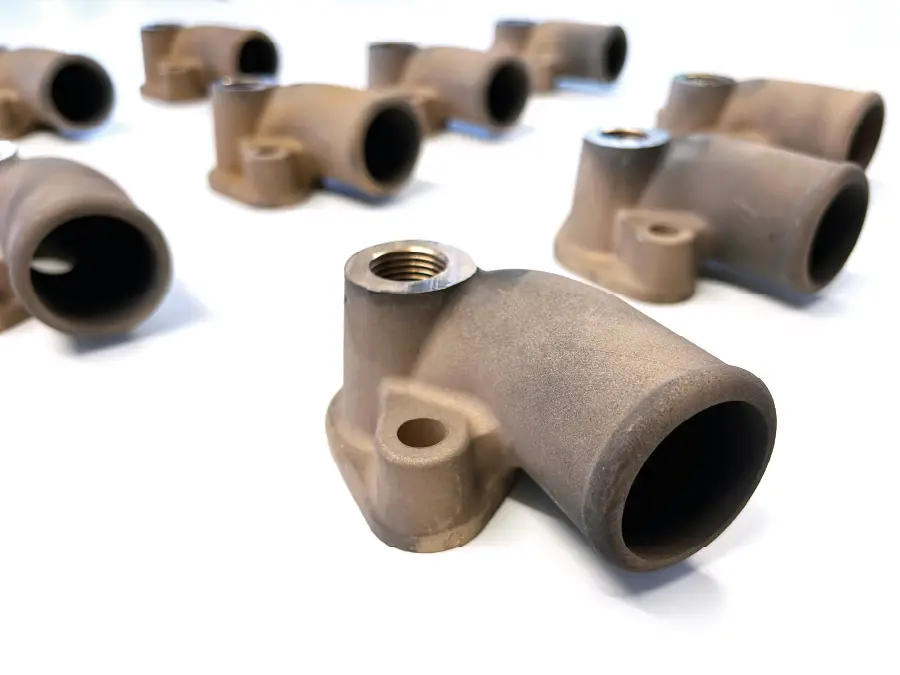
MAN urgently needed ten bronze elbows for the cooling water supply of a marine engine. The original supplier no longer existed, and recasting the parts would have been neither fast nor economical. Working from the existing 3D model and production drawings, Replique selected a suitable material and manufacturing partner. The ready-to-install parts were delivered seven weeks after the request, with no tooling or storage costs and no minimum order quantity. Read the MAN success story
Alstom: one impeller instead of a whole block
An impeller in the cooling system of a metro in Asia failed. The original manufacturer’s only solution was to replace the complete block. Instead, Replique reproduced the impeller using metal 3D printing and handled all post-processing from a single source: machining to tolerance, balancing and corrosion protection. The part is currently going through series approval. Read the Alstom success story
No drawing, no CAD model?
Our engineering experts help you with the data and with choosing the right process.Plan ahead instead of reacting: the digital spare parts inventory
If you have had to reproduce a part once, make the most of it. Once the CAD model, material and process parameters are defined and qualified, the same part can be reordered at any time. Instead of physical stock on a shelf, you keep a digital record, and the part is only produced when needed, ideally close to where it will be used.
This pays off especially for parts in long-lived equipment with low and hard-to-forecast consumption. Typical examples are rail, energy, mechanical engineering and commercial vehicles. Our article on obsolescence management in rail describes how operators approach this.
A good place to start is a list of parts that have been hard to source in recent years or that now depend on a single supplier. From that list, you can identify candidates for a digital inventory before the next failure happens.
FAQ
Getting started
What can I do if a spare part is no longer available?
First clarify urgency, available data, function and quantity. Then ask your current supplier about successor parts, remaining stock or a last-time buy. If that doesn’t work, a new supplier or reproduction by CNC machining, casting or 3D printing are the next options. If there are no drawings, the part is digitized first through reverse engineering.
What can I do if my supplier only delivers high minimum order quantities?
Check whether the part can be made without tooling, for example by 3D printing or CNC machining. Neither process requires a minimum order quantity, so you only order the number of parts you actually need. That avoids tied-up capital and excess inventory.
What is a last-time buy?
A last-time buy is the final order a supplier accepts before discontinuing a part. The buyer uses it to cover their estimated demand for the remaining life of their products or equipment. The risk lies in the forecast: too few parts lead to shortages later, too many tie up capital and often end up being scrapped.
Can a spare part be reproduced without a drawing?
Yes. The original part or an identical sample is measured, for example with a 3D scanner, and a CAD model is created from it. This model then serves as the basis for production and for every future reorder.
Is it legal to reproduce spare parts?
If you designed the part yourself and only had it made by a supplier, having it produced by another partner is usually not a problem, as long as the supply contract doesn’t say otherwise. For third-party parts, the EU Trade Secrets Directive generally allows lawfully acquired products to be studied and disassembled. However, patents, registered designs, trademarks and contractual agreements may stand in the way in individual cases and should be checked.
Costs and lead times
How much does it cost to have a spare part reproduced?
That depends on size, material, process, tolerances and quantity. For one-offs and small batches, 3D printing is often cheaper than casting or injection molding because there are no tooling costs. Whether reverse engineering is needed also affects the price.
How quickly can an obsolete spare part be reproduced?
With existing data, anything from a few days to several weeks is realistic, depending on the process and post-processing. For MAN Truck & Bus, ten ready-to-install bronze parts were delivered seven weeks after the request, including material selection.
Which spare parts are suitable for 3D printing?
Good candidates are parts needed in small quantities, parts with complex geometries, and parts whose tooling no longer exists. This ranges from plastic covers and brackets to metal components such as impellers or elbows. Part size, material, tolerances and mechanical loads are the deciding factors.
What is a digital spare parts inventory?
Instead of stocking spare parts physically, their CAD data and process parameters are stored digitally, and parts are only produced when needed. This saves warehousing costs and tied-up capital, and protects against the risk of a part eventually becoming impossible to source.