Industry 4.0 has been promising connected factories, predictive maintenance and data-driven decisions for years. In practice, most projects never get past the pilot stage. On-demand manufacturing is one of the few applications where that is changing: it relies on the building blocks of Industry 4.0 – sensors, connected data, digital platforms – and puts them to practical commercial use. This article explains how the two concepts fit together, where manufacturers can start, and what it takes to move from theory to everyday operations.
Why Industry 4.0 stalls at many manufacturers
Heavy investment, unclear returns
The idea behind Industry 4.0 is straightforward: connect machines, capture production data, make better decisions based on that data. Yet adoption remains slow. According to VDMA analysis, fewer than 20 % of mid-sized German manufacturers have moved Industry 4.0 concepts beyond the pilot stage. The problem is rarely a lack of interest – most companies simply struggle to translate a dashboard full of machine data into a tangible business advantage.
On top of that, the sector is already under pressure. The VDMA has recorded declining order intake since early 2023, and capacity utilisation sits at around 78 %, well below the long-term average. In that kind of environment, committing large budgets to digitalisation projects that may take years to pay off is a tough sell.
Too much technology, too little value creation
Many Industry 4.0 initiatives fail not because of the technology, but because of the approach. As Slalom notes in its 2026 manufacturing outlook, isolated proof-of-concept cycles have delivered limited value over the years – largely because they were never embedded in existing business processes. A sensor on a machine produces data. But what happens with that data? Who acts on it? And which process actually changes as a result?
On-demand manufacturing addresses exactly these questions – using the building blocks that Industry 4.0 provides. Sensors detect wear on equipment. Connected systems match the finding against a digital parts catalogue. A platform routes the production data to the nearest manufacturing partner – and the part arrives on time, without ever having sat on a shelf.
Industry 4.0 provides the infrastructure – connected machines, digital part data, decentralised production networks. On-demand manufacturing turns that infrastructure into a business process that translates directly into savings and availability.
On-demand manufacturing as a practical Industry 4.0 starting point
What on-demand manufacturing actually means
On-demand manufacturing means a part is only produced when someone actually needs it. The foundation is a digital parts library – qualified production data (CAD models, material specifications, manufacturing parameters) that can be sent to a production network and manufactured at any time. Depending on the part, via 3D printing, CNC machining or another process. Instead of storing thousands of spare parts in a warehouse, the inventory exists only as a data set until an order comes in.
That has far-reaching consequences for inventory and logistics: tied-up capital in warehouses disappears, because nothing is pre-produced. Parts cannot become obsolete, because they only come into existence when they are needed. And long shipping routes get shorter, because the part is manufactured where it is required. A systematic literature review covering 77 studies confirms these effects: lower inventory levels, shorter lead times and less downtime during maintenance.
How Industry 4.0 and on-demand manufacturing work together
On-demand manufacturing builds on the building blocks of Industry 4.0 and gives them a practical purpose. A typical sequence illustrates the interplay: IoT sensors on a piece of equipment capture wear and operating data. That data flows into a connected system monitoring component condition. Once a threshold is reached, the system automatically matches the demand against the digital parts library. The production data – geometry, material, tolerances, manufacturing process – goes to the nearest partner in the network. The parts are manufactured and delivered before an unplanned stoppage occurs.
Taken individually, each of these steps is a standard Industry 4.0 element. Together, they form an end-to-end process that feeds directly into equipment availability and operating costs.
Why this particular application works
Compared with many other Industry 4.0 use cases, on-demand manufacturing has a practical edge: the benefits are visible immediately. Every part that no longer sits in a physical warehouse saves space, administration and capital. There is no need for a company-wide IT transformation or a multi-year implementation timeline. You start with a handful of parts and expand gradually.
At the same time, the technical barriers are falling. According to a TEEPTRAK analysis, plug-and-play solutions can now connect a machine to a digital infrastructure in under two hours – a step forward that opens up these models to small and mid-sized companies as well.
How many of your spare parts could move to a digital inventory?
We assess your portfolio for on-demand manufacturing suitability – free and with no obligation.From physical warehouses to digital spare-parts inventory
The cost of conventional spare-parts storage
Holding spare parts is expensive – and not just because of the floor space. Total costs include tied-up capital, insurance, handling, shrinkage and, above all, obsolescence. An analysis by Metal AM puts the annual total cost of inventory holding at roughly 20 % of the part’s value. A part worth €100 that sits on a shelf unused for five years will have consumed its own value in carrying costs alone – without ever being installed.
For manufacturers with large portfolios, this is a serious burden. Arthur D. Little describes a utility company that analysed 700,000 spare-part line items and subsequently restructured its procurement strategy in multiple phases towards additive manufacturing. Many companies with long-lived capital equipment – machinery, vehicles, industrial plant – face the same challenge: parts must remain available for decades, even though suppliers and tooling are long gone.
How a digital inventory works
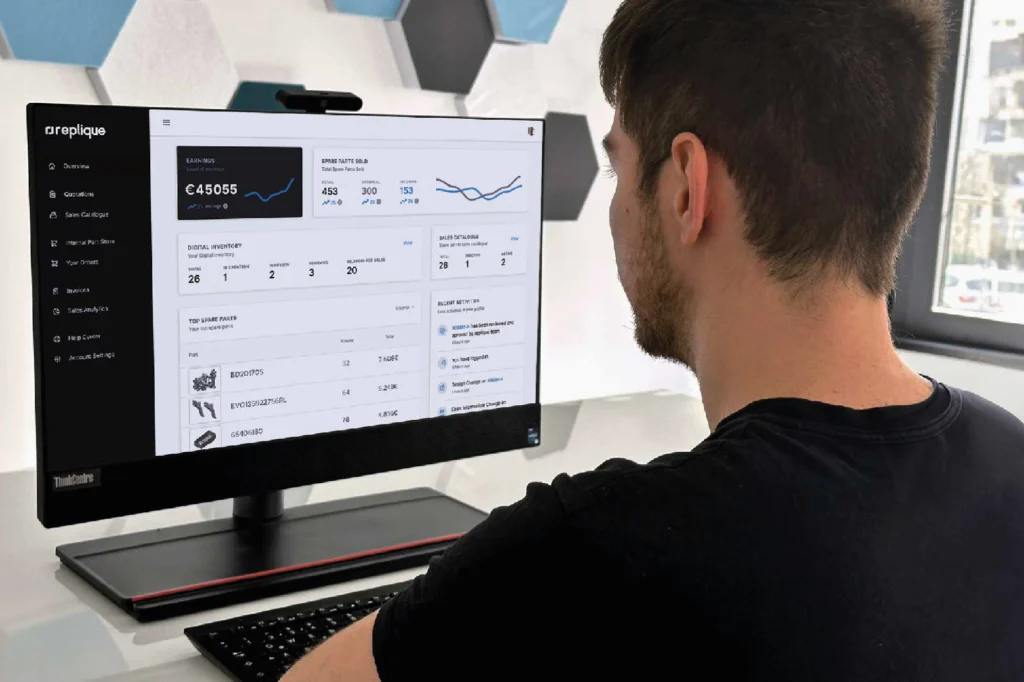
A digital spare-parts inventory replaces physical stock with qualified, production-ready CAD files. When a part is needed, the data is sent to a manufacturing partner who produces it in the required technology and quantity – whether by 3D printing, CNC machining or another process.
Replique operates exactly this kind of system: the platform connects an encrypted digital warehouse with a network of more than 450 certified production partners worldwide. OEMs store their production data there – CAD models, material specifications, manufacturing parameters – and can order parts at any time, in the right quantity, at the right location, with no minimum order quantities. Quality assurance runs through defined manufacturing parameters and inspection protocols, regardless of whether a part is produced by 3D printing, CNC or another method. This eliminates the need for physical stockholding across multiple regional warehouses – parts only come into existence when someone actually needs them.
| Criterion | Physical warehouse | Digital inventory + on-demand |
|---|---|---|
| Capital tied up | Approx. 20 % of part value per year, regardless of demand | Zero until an order is placed |
| Obsolescence risk | Parts age physically, end up scrapped | Eliminated – digital data is versioned |
| Lead time when needed | Fast for stocked items, weeks if out of stock | Days, manufactured at the nearest partner |
| End-of-life part coverage | Difficult: tooling and suppliers often no longer available | Permanent, via reverse engineering and digital archive |
| Carbon footprint | High: global shipping, overproduction, disposal | Lower: local production, no overproduction |
Moving from pilots to scaled operations
The industry is investing – but in foundations
The direction is right: Deloitte’s smart manufacturing survey of 600 executives found that 80 % of respondents plan to allocate more than 20 % of their improvement budget to smart manufacturing initiatives. But the focus is on fundamentals: data analytics, sensors, cloud infrastructure. That makes sense – no advanced application works without clean data. It also means, however, that many companies are still years away from truly scaled use cases.
On-demand manufacturing fits into this picture because it does not require a company-wide data platform. Getting started takes qualified CAD data and access to a production network – nothing more. Companies can begin with a manageable portfolio, typically slow-moving spare parts with high carrying costs, and expand from there.
Getting started: begin small, scale deliberately
In practice, the transition starts with an analysis of the existing part portfolio. Which parts are rarely needed but tie up capital? Which parts are hard to source because suppliers or tooling no longer exist? Which parts are technically suitable for additive manufacturing or CNC machining in small batches?
As a rule of thumb, around 7–10 % of a typical spare-parts portfolio is directly suitable for additive manufacturing – and that share grows further when CNC machining and other processes are included. That may sound modest, but these tend to be the most problematic parts in any warehouse: infrequently needed, expensive to store, difficult to reorder. Starting with them delivers the biggest commercial impact for the least effort.
Planning the next step in your Industry 4.0 strategy?
Replique connects your digital spare-parts inventory with 450+ production partners worldwide.FAQ
Basics
What is the difference between Industry 4.0 and on-demand manufacturing?
Industry 4.0 is the overarching concept of connected, data-driven production. On-demand manufacturing is a specific application within that framework: it uses digital part data to produce components only when they are actually needed, rather than manufacturing and storing them in advance.
Do I need a full Industry 4.0 infrastructure to use on-demand manufacturing?
No. Unlike many other Industry 4.0 applications, on-demand manufacturing does not require a company-wide data platform. Getting started takes qualified CAD data and access to a production network. IoT sensors, digital twins and predictive maintenance are useful additions, but not prerequisites.
Which parts are suitable for a digital inventory?
Parts with low, irregular demand and high carrying costs are the best candidates – typically slow-moving spare parts. End-of-life parts where tooling or suppliers no longer exist are also ideal. A range of manufacturing processes can be used: 3D printing, CNC machining, sheet-metal work or investment casting, depending on material and geometry.
How do Industry 4.0 technologies and on-demand manufacturing work together?
They form a chain: IoT sensors capture machine condition, connected systems identify spare-part demand, a digital platform holds the production data and routes it to the nearest manufacturing partner. Each step on its own is a standard Industry 4.0 building block – together they become an end-to-end process that cuts inventory costs and reduces downtime.
Economics
Isn’t on-demand manufacturing more expensive than conventional mass production?
On a per-unit basis, often yes – but that is the wrong comparison. When you factor in total costs (warehousing, tied-up capital, obsolescence, overproduction, disposal), on-demand is cheaper for many parts. Annual carrying costs alone typically run at around 20 % of the part’s value.
Is it worth it for small and mid-sized companies?
Often especially so: companies with a manageable but expensive spare-parts portfolio feel the relief in capital and floor space right away. Getting started through an external production network requires no in-house printer fleet.
Practice
How does the transition from physical to digital inventory work?
It starts with an analysis of the existing portfolio against technical and commercial criteria: material, geometry, demand frequency, carrying cost. This is followed by test prints, qualification and integration into existing ordering workflows. Most manufacturers start with a limited number of parts and expand progressively.
What about parts where no CAD data exists?
Particularly with older equipment, digital design data is often missing. In those cases, parts can be digitised through reverse engineering – for example via 3D scanning or from technical drawings – and then stored in the digital warehouse.