Few manufacturers still make every part in-house. Sometimes the right machine isn’t available, sometimes there aren’t enough skilled operators, and sometimes the investment simply doesn’t pay off for a small batch. With contract manufacturing, an external partner produces parts to your drawings and specifications and takes care of material sourcing, inspection and delivery. You’ll often hear the term toll manufacturing in the same context. This article explains how the two models differ, when contract manufacturing makes sense and what to look for when choosing a contract manufacturer.
- What is contract manufacturing?
- Contract manufacturing vs. toll manufacturing
- The contractual side of contract manufacturing
- Benefits of contract manufacturing
- Which parts are suited?
- Risks and how to manage them
- How to choose the right contract manufacturer
- A single supplier or a manufacturing network?
- FAQ
What is contract manufacturing?
In contract manufacturing, a company outsources the production of parts or assemblies to a specialised service provider. The customer supplies the design: CAD data, drawings, tolerances and quality requirements. The contract manufacturer buys the material, produces the parts on its own equipment with its own staff and delivers finished components. Post-processing, surface finishing, inspection and documentation are often part of the package.
For the customer, this cuts coordination effort considerably, because you order a part rather than machine hours. Design know-how and product responsibility stay with you, while production sits with the contract manufacturer.
Contract manufacturing vs. toll manufacturing
The two terms are often used interchangeably, but strictly speaking they differ in who provides the material. In toll manufacturing (also called toll processing), the customer supplies the raw material or semi-finished stock, such as bar stock, sheet metal or cast blanks. The toll manufacturer processes it and charges mainly for labour and machine time. In contract manufacturing, the supplier sources the material itself and includes it in the unit price.
Toll manufacturing makes sense if you buy material on favourable framework terms, need to prove the origin of a specific batch or want to use up existing stock. Purchasing and material logistics then remain your job. If you’d rather hand that over too, contract manufacturing is the better fit.
| Criterion | In-house production | Toll manufacturing | Contract manufacturing |
|---|---|---|---|
| Material | bought in-house | supplied by the customer | sourced by the manufacturer |
| Capital investment in machines | high | none | none |
| Coordination effort | high internally | medium (material logistics) | low |
| Billing | internal costs | mainly labour and machine time | unit price incl. material |
| Best suited for | core competencies, high utilisation | material control, batch traceability | freeing up capacity, special processes, fluctuating demand |
The contractual side of contract manufacturing
Who supplies the material also matters legally, and the rules vary from country to country. Take German law, which applies to many contracts with German suppliers. If the contract manufacturer produces goods from its own material, Section 650 of the German Civil Code (BGB) largely applies the rules of sale. Between businesses, Section 377 of the German Commercial Code (HGB) then requires the buyer to inspect goods promptly on delivery and report defects without delay, otherwise warranty claims may be lost. A well-established incoming inspection, or an inspection report supplied with the parts, is therefore more than a formality.
Toll manufacturing, where supplied material is processed, is usually treated as a contract for work under Section 631 BGB. Whatever the contract type, every agreement should clearly cover confidentiality, rights to design data and tooling, delivery performance and quality documentation. For the details of your contract, it’s worth getting legal advice.
Before the first order goes out, it should be agreed in writing who is responsible for material, inspection and documentation. Most disputes in contract manufacturing arise exactly at these interfaces.
Got the drawings but no spare capacity?
We manufacture your parts to your specifications, from prototype to series production.Benefits of contract manufacturing
Relief from skills shortages and capacity bottlenecks
Skilled workers remain hard to find. In Germany, the DIHK Skilled Labour Report 2025/2026 found that 36 percent of industrial companies have difficulty filling vacancies because suitable staff are lacking. In metal production and processing the figure is 42 percent, in mechanical engineering 38 percent. Companies that can’t find machinists or CNC operators often struggle to absorb peaks in demand internally. A contract manufacturer can take on those volumes without you having to hire.
Less capital tied up
A 5-axis milling machine, an industrial 3D printer or an injection mould ties up a lot of money. For processes you only need occasionally, the investment rarely pays off. With contract manufacturing you pay only for the parts you actually need, which also makes costs easier to plan.
Access to specialised processes
Hardly any company masters every process from investment casting and laser cutting to metal 3D printing. Specialised contract manufacturers have the equipment and the experience. That lets engineers pick the process that works best technically and economically, instead of designing around the machines they happen to have.
Focus on your core business
The classic make-or-buy question is where you actually create value. If your strengths lie in development, system integration or service, outsourcing standard parts frees up time and resources for exactly that.
Which parts are suited to contract manufacturing?
Not every part has to be outsourced. Contract manufacturing pays off most where in-house production would be expensive, slow or simply not possible. Typical examples from practice:
- Prototypes and samples: housings, brackets or functional prototypes that change several times during development. With 3D printing or CNC milling they’re ready within days, without tying up your own machines.
- Jigs, fixtures and tooling: robot gripper fingers, assembly aids, inspection gauges or drilling templates are often needed in small numbers only and tailored to a specific line.
- Spare parts for older machines: gears, bushings, levers or covers the original manufacturer no longer supplies. If drawings are missing, they can be reproduced through reverse engineering and made on demand instead of being kept in stock.
- Small batches: plastic housings, covers or clips in quantities from a few dozen to a few thousand, where a dedicated injection mould doesn’t pay off yet.
- Parts with complex geometry: components with internal cooling channels, lattice structures or undercuts, such as heat exchangers or lightweight brackets, are hard to make conventionally but well suited to metal 3D printing.
- Turned, milled and sheet metal parts outside your core know-how: shafts, flanges, spacers, mounting plates or sheet metal covers with widely fluctuating demand.
Spare parts in particular are becoming more important, as manufacturers will have to keep parts available for longer. Read more in our article on the EU Right to Repair.
Contract manufacturing is less suitable for parts that embody your core production know-how, or for high-volume series that run on your own well-utilised equipment. In those cases, in-house production is usually more economical. If in doubt, compare properly and factor in set-up times, storage costs and tied-up capital, not just the unit price.
Risks of contract manufacturing and how to manage them
Outsourcing production always means giving up some control. The typical risks are easy to manage once you know them.
- Inconsistent quality: Define inspection characteristics, tolerances and measurement reports up front. A certified quality management system to ISO 9001 is a sensible minimum, and industries such as automotive or aerospace add their own standards.
- Protecting know-how: Design data is among your most valuable assets. Agree on confidentiality and check how files are transferred and stored. ISO/IEC 27001 certification shows that a partner manages information security systematically.
- Dependence on a single supplier: If your only contract manufacturer drops out, your assembly line may stop. A second source or a partner with several production sites reduces that risk.
- Coordination overhead: Queries about drawings, revision changes and rescheduled deadlines take time. A dedicated contact person and clean documentation of every change help.
How to choose the right contract manufacturer
The lowest unit price tells you little about whether a partnership will work. Check these points before placing an order:
- Technology and material: Does the manufacturer master the required process and have experience with your material?
- Certifications: Is ISO 9001 in place, plus any industry-specific certifications you need?
- Volumes: Does the supplier fit your demand? Some specialise in one-offs, others only become economical at larger batch sizes.
- Lead times and on-time delivery: Ask for realistic lead times and references.
- Inspection and documentation: What measuring equipment is available, and which documents (first article inspection report, material certificate) come with the parts?
- Communication: How quickly do quotes and answers to technical questions arrive?
If you regularly need parts made with different processes, the search quickly becomes time-consuming, since every new supplier has to be contacted, qualified and onboarded. We’ve looked at what that involves in our article on finding manufacturing suppliers.
No time to search for suppliers?
One point of contact for CNC, 3D printing, casting and sheet metal, backed by vetted partners.A single contract manufacturer or a manufacturing network?
A single local supplier is often the right choice if you need the same part in similar quantities for years and value being close by. It gets harder when demand fluctuates, several processes are involved or a bottleneck has to be bridged at short notice.
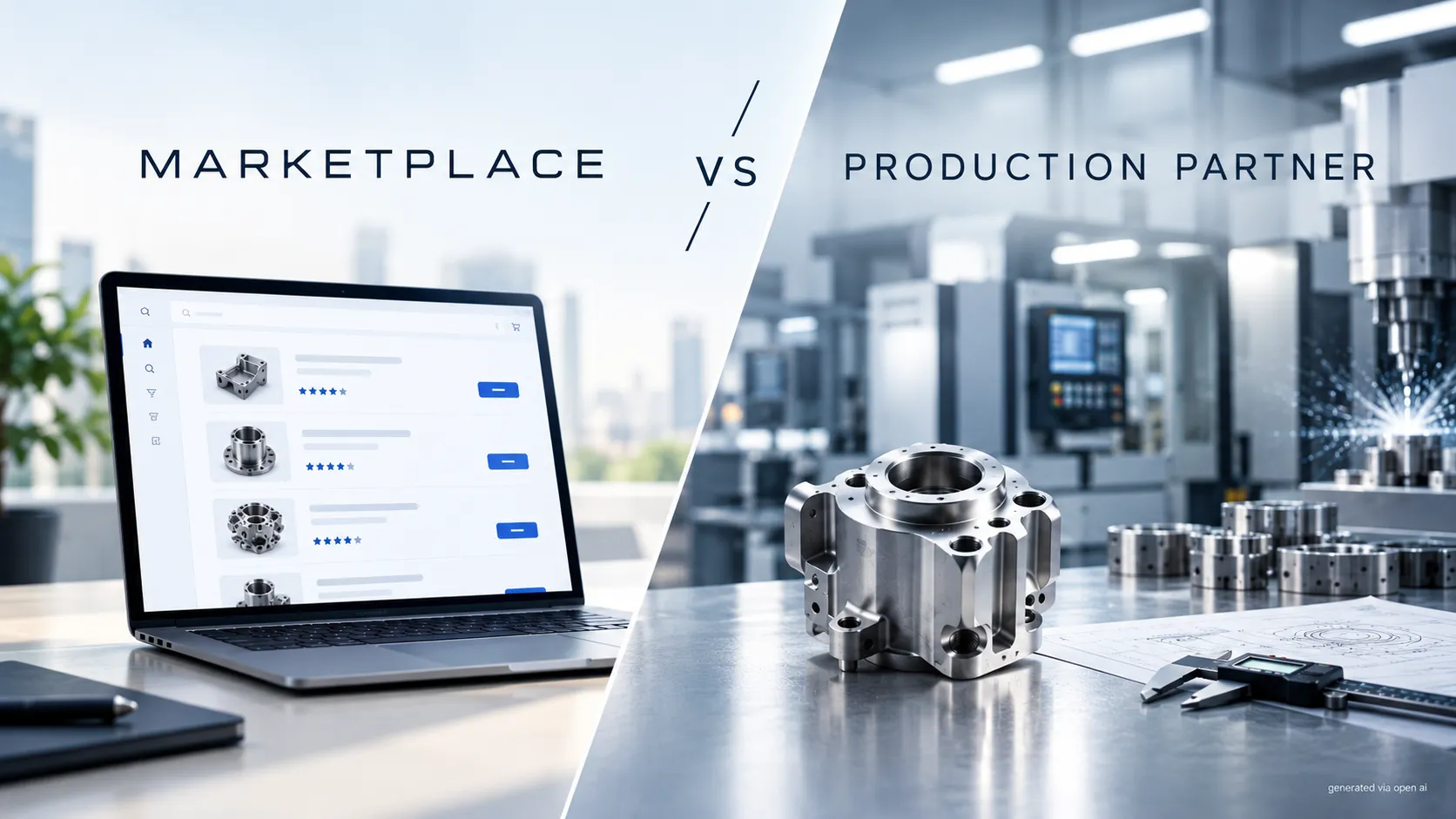
That’s where Replique comes in. As an all-in-one contract manufacturer, we handle the entire process: we review your data, select the right production partner from a network of more than 450 certified manufacturers worldwide, source the material, manage production and check quality. You have one contract partner and one contact person, even when your parts are made using different processes. Replique itself is certified to ISO 9001 and ISO/IEC 27001.

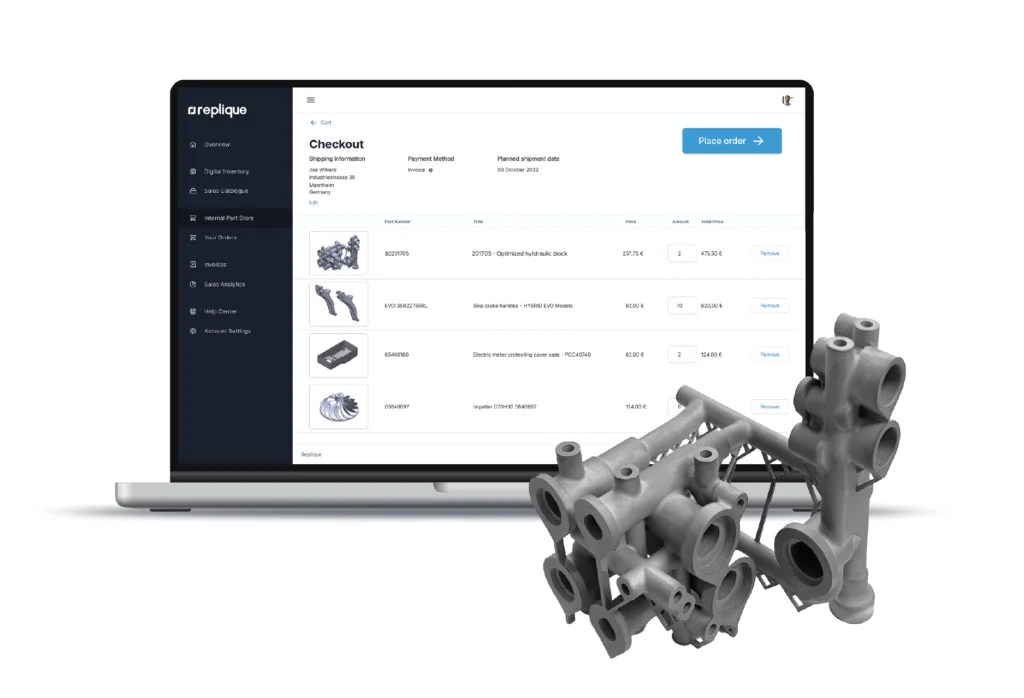
On the Replique platform, you upload your CAD files, receive a reviewed quote and track the status of your orders. This works for prototypes and small batches as well as recurring series parts or urgently needed spare parts.
FAQ
The basics
What is contract manufacturing?
In contract manufacturing, an external service provider produces parts to the customer’s drawings and specifications. It sources the material, manufactures on its own equipment and delivers finished, inspected parts.
What is the difference between contract manufacturing and toll manufacturing?
In toll manufacturing, the customer supplies the material and the manufacturer mainly charges for labour and machine time. In contract manufacturing, the supplier sources the material itself and delivers the finished part at a unit price. In everyday use, however, the terms are often treated as synonyms.
What type of contract applies to contract manufacturing?
That depends on the applicable law. Under German law, the rules of sale largely apply when the manufacturer produces goods from its own material (Section 650 BGB), including the buyer’s duty to inspect and give notice of defects between businesses (Section 377 HGB). Processing supplied material is usually a contract for work. Have your specific case checked by a lawyer.
What quantities is contract manufacturing suitable for?
Basically any quantity. For one-offs and prototypes you save on machine investment, and for series production you benefit from the experience and capacity of specialised manufacturers. What matters is that the process and partner match the batch size.
Choosing a partner and working together
How do I recognise a good contract manufacturer?
Look for the right technologies, a certified ISO 9001 quality management system, transparent inspection processes, realistic lead times and fast, technically sound communication. References from your industry are a good sign.
How do I protect my design data in contract manufacturing?
Sign a non-disclosure agreement, settle the rights to data and tooling, and transfer files only through secure channels. A partner certified to ISO/IEC 27001 has shown that information security is organised systematically.
Which manufacturing processes does Replique offer?
Through our network of more than 450 certified partners, we manufacture using 3D printing (e.g. SLS, MJF, DMLS), CNC machining, casting, injection moulding and sheet metal fabrication, among others, with post-processing on request.