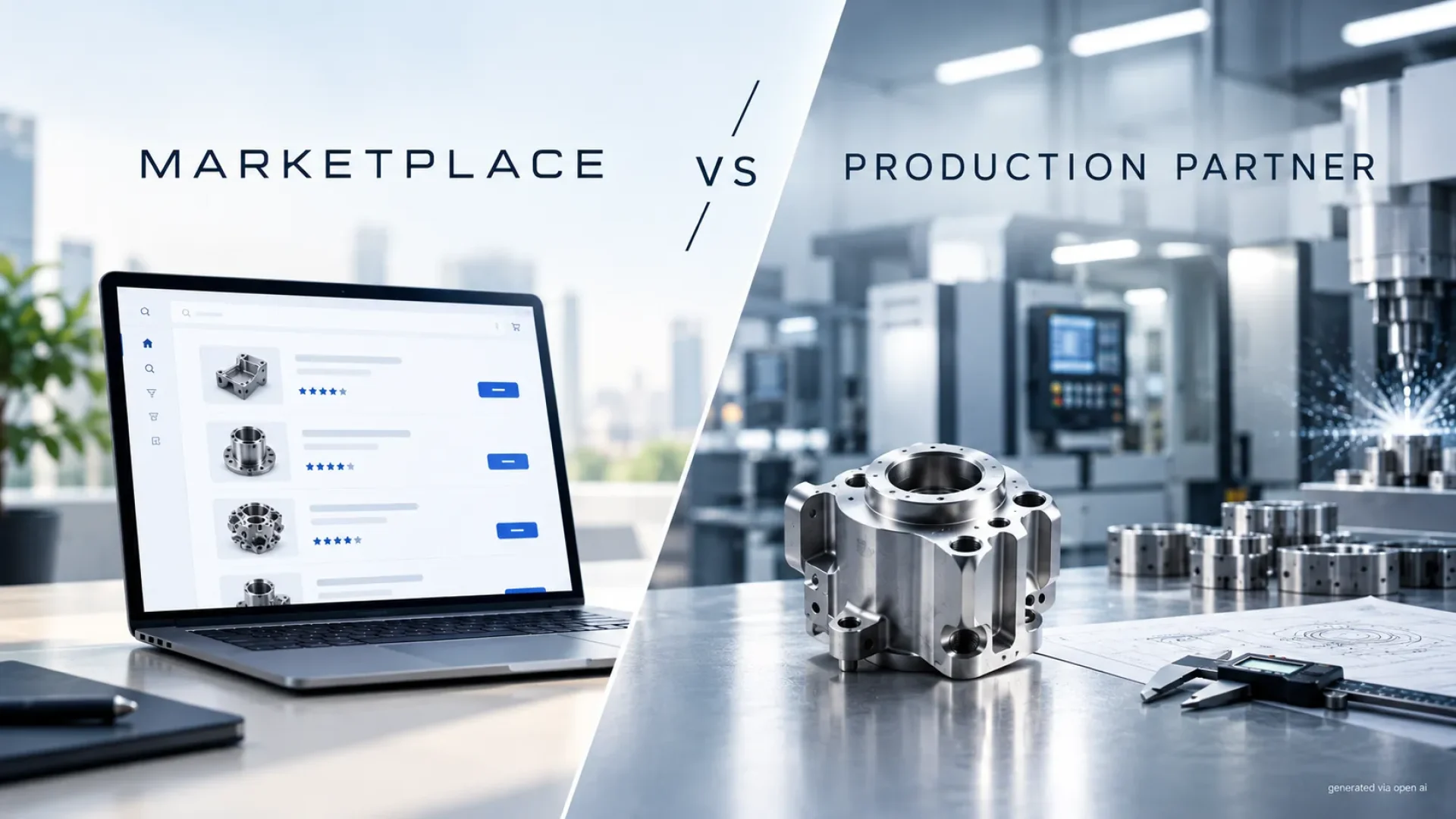
Anyone sourcing manufacturing capacity today can choose from a growing number of digital manufacturing platforms. Some are open marketplaces built around an automated instant quote; others treat procurement as an end-to-end process that begins with a technical review. This overview sorts the best-known providers by model, quoting approach and typical use case — and why, for demanding parts, how the quote comes about often says more about the effort ahead than the size of the supplier network.
Three basic models of manufacturing procurement
Before weighing platforms against each other, it helps to look at the underlying model. Broadly speaking, there are three approaches.
Open marketplaces
Providers such as Xometry connect buyers with a large, open network of manufacturing partners and usually return a quote automatically once a file has been uploaded. This delivers breadth across processes and materials, but it also means part of the quality assurance sits with the individual supplier.
In-house production with fixed capacity
Protolabs takes the opposite route and manufactures in its own factories. That cuts coordination effort and makes lead times more predictable, but it narrows the range of processes and materials compared with open marketplaces.
Managed procurement with technical review
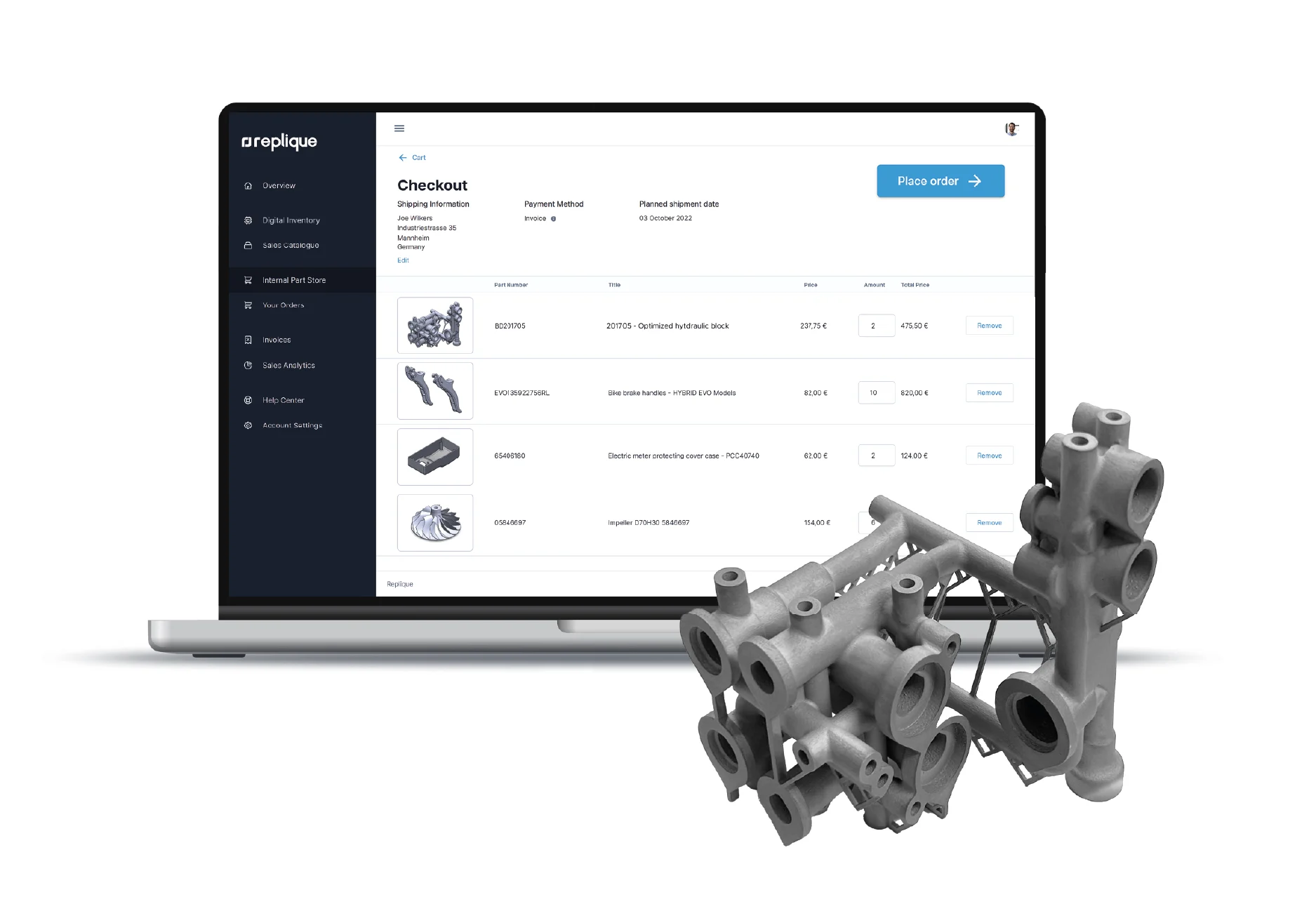
A third approach, taken by Fictiv in the enterprise space and by Replique, puts the whole procurement process at the centre rather than manufacturing alone: technical review of the part, selection of process and material, and the question of where and when production happens. At Replique this spans the initial qualification of a part, recurring series deliveries and a digital part library from which repeat parts are produced on demand. The decisive point is that a part is qualified once and then remains reorderable reproducibly at the same quality — whether it feeds a running series or an occasional call-off.
Instant quote or technical review?
One distinction often gets lost in platform comparisons: how the quote is actually produced. It shapes the effort you face later far more than the number of partners in a network.
Automated instant quotes are fast, and for simple geometries with non-critical tolerances they are hard to beat. With demanding parts, though, the model runs into limits. An algorithm that derives a price from a STEP file interprets neither GD&T callouts on a 2D drawing nor the question of whether the chosen process is suitable for the required function at all. The promise of uploading a file and receiving a price assumes the geometry contains everything essential — and with drawing-defined parts that is rarely the case. It can then happen that the price quoted at first is reopened once the manufacturing partner has reviewed it, or that the part has to be reworked.
An instant quote is only as reliable as the assumptions behind it. With critical parts, what matters is not how quickly the price arrives, but whether someone has checked that the part can be manufactured as specified.
Replique deliberately does without a purely algorithmic instant price. Instead, an engineering team reviews every enquiry technically before a quote goes out: is the part suitable for the intended process, which material meets the requirements, and which partner in the network can actually deliver the specified tolerances and certifications? Against an instant quote that costs time at the start, but it moves the technical questions to the front of the project instead of into rework once the part has already been made.
The difference grows with the complexity of the part. On a milled bracket in standard aluminium there is little to interpret. But as soon as several manufacturing steps hang together — casting followed by machining, heat treatment, surface finishing — the upfront review decides whether the process chain fits together at all. Shrinkage allowances, machining stock, distortion from heat treatment: no algorithm reads dependencies like these out of a solid geometry, and a mistake here only surfaces on the finished part.
The platforms in detail
The profiles below describe business models and areas of focus, not quality judgements. Which platform fits depends on the part and the requirement: each of those named is a sensible choice in its own field. Figures on network size, certifications and locations come from the providers themselves and may change.
Xometry
Xometry is a publicly listed, AI-supported manufacturing marketplace with very broad process coverage, from CNC machining and 3D printing to injection moulding and sheet metal. As the company itself reports in its results announcement for the third quarter of 2025, marketplace gross margin reached 35.7 per cent. That spread between buyer and manufacturer funds the platform, the handling and the quality commitments. For buyers who want to handle many different processes through a single platform, the breadth remains a clear advantage.
Strong for: the widest choice of processes and materials, a price in minutes, a vast partner network with matching spare capacity, mature self-service.
Less suitable when: a technical review of the specification before the quote is what you want, or a fixed allocation to one manufacturing shop across several batches. Neither is something an open marketplace model provides by default.
Protolabs
Protolabs manufactures in its own plants and is accordingly regarded as particularly fast and predictable for prototypes and small batches. Because everything runs in-house, lead times are easy to calculate and quality stays consistent across repeat orders — nobody routes the job to a different shop for the second batch. That same in-house production, however, limits the choice of processes and materials.
Strong for: very short throughput times, predictable dates, consistent quality through in-house production, automated DFM feedback on upload.
Less suitable when: a process or material is needed that is not part of the in-house machine park — with in-house production the selection follows what stands in the factories.
Fictiv
Fictiv positions itself as managed manufacturing for enterprise programmes, including project management from enquiry through to quality control. In April 2025 the company was acquired by Japan’s MISUMI Group, whose notice regarding the acquisition names four manufacturing regions — the US, Mexico, India and China — and around 250 manufacturing partners as of December 2024. Spreading production across several regions is an advantage when tariff exposure needs to be distributed.
Strong for: project management from enquiry through to quality control, production across four regions and with it the option to spread tariff exposure, plus the backing of a large industrial group since the MISUMI acquisition.
Less suitable when: production should sit in Europe — the regions named in the acquisition notice lie in North America and Asia.
MakerVerse
MakerVerse is a Berlin-based joint venture of Siemens Energy and ZEISS. Its vetted partner network is, by its own account of its supply chain, built in two tiers: standard suppliers based in Europe for shorter lead times, and economy suppliers located internationally for price advantages. All manufacturing partners are ISO 9001 certified, some additionally in fields such as IATF 16949 or AS 9100. Quotes are generated algorithmically once the file is uploaded, including an automated DFM check; process and material are selected by the requester.
Strong for: a choice between a European or an international supply chain, a curated rather than open network, consistently ISO 9001 certified partners, and industrial quality expectations rooted in the Siemens Energy and ZEISS background.
Less suitable when: the choice of process and material should come from the provider rather than being made by you at upload.
Replique
Replique is a digital contract manufacturer for industrial parts and covers several processes through a partner network focused on Europe with locations worldwide — CNC machining, forging, casting, injection moulding and 3D printing. It is not just the single step that gets manufactured: downstream processes such as machining after casting, heat treatment or surface finishing run through the same platform, so multi-stage process chains do not have to be spread across several suppliers. What sets it apart from the instant-quote marketplaces is the sequence: enquiries are reviewed technically before a quote is created, including a recommendation on process and material. That makes the platform particularly relevant for parts with documentation, tolerance or certification requirements, where an automatically generated price says little.
Qualified series production is a substantial part of the business: process, material and inspection scope are defined together with the customer and released, after which the part is manufactured reproducibly in recurring batch sizes, with consistent documentation across every call-off. For repeat and spare parts, the same qualified data set can be stored in the digital part library, so production happens on demand instead of tying up physical stock.
The platform consolidates enquiry, ordering, fulfilment, documentation and quality tracking, and integrates with existing systems such as ERP landscapes, ARIBA or web shops. Replique is certified to ISO 9001 and ISO 27001, and the platform is used by companies including Alstom, MAN, Danfoss, Roche and Miele.
Strong for: technical review before the quote, a broad partner network focused on Europe with locations worldwide — more than 450 manufacturing partners in total. The entire process chain is covered across several manufacturing steps, including post-processing, heat treatment and surface finishing. On top of that, consistent documentation across recurring batches, ISO 9001 and ISO 27001, plus integration with ERP and procurement systems.
Less suitable when: a price in seconds is what you need — the first enquiry goes through the engineering team.
Curious how this works in practice?
Find out how Replique consolidates your parts procurement across several processes.Comparison table
| Platform | Model | Quoting | Strength |
|---|---|---|---|
| Xometry | Open marketplace | Largely automated | Widest choice of processes and materials |
| Protolabs | In-house production | Largely automated | Speed for prototypes and small batches |
| Fictiv | Managed manufacturing | Automated, with programme support | Multi-region programmes for enterprise customers |
| MakerVerse | Curated partner network | Automated | Choice of supply chain, certified partners |
| Replique | End-to-end procurement | Technical review by engineering | Multi-stage process chains, qualified series, ERP integration |
A specific part with specific requirements?
Our engineering team reviews your enquiry and recommends process and material.Which platform suits which requirement?
For a single prototype or an urgent small batch, marketplaces such as Xometry or in-house manufacturers such as Protolabs are usually the most direct route: upload the file, get a price, place the order.
Things look different when the specification itself is the hard part: tight tolerances, mandatory certifications, materials with defined properties, or drawings carrying GD&T callouts. Here an upfront technical review pays off, because otherwise the queries and the rework simply shift into production.
That applies above all to recurring series deliveries, where the first price matters less than whether batch 20 still matches the inspection report of batch 1. Once a part has been qualified, the real value of a platform lies in reproducibility: same process, same material, same documentation, regardless of which partner in the network manufactures it. Managed models such as Fictiv, MakerVerse and Replique are built around exactly this, while open marketplaces leave more of the quality responsibility with the individual supplier.
Parts needed rarely and unpredictably remain a special case — for machine fleets, rail vehicles or equipment in the field. As the World Economic Forum describes, the digital inventory is gaining ground here: instead of physical stock, a database of ready-to-produce parts offsets stock-keeping costs and frees up capital otherwise locked in slow-moving replacement parts. Replique allows both to be combined, because the same qualified data set serves the running series and the later repeat order.
FAQ
What is the difference between a manufacturing marketplace and a procurement platform?
A pure marketplace mainly brokers contact between buyer and supplier. A procurement platform such as Replique also takes on process steps: technical review of the part, selection of process and material, qualification of series parts including documentation, and integration with existing ERP systems.
Why does Replique not offer an automatic instant quote?
Because an algorithmically generated price says little about demanding parts. Whether a process suits the required function, which material meets the specification, and which partner can deliver the necessary tolerances and certifications cannot be derived from a CAD file alone. The upfront technical review takes a little time but avoids rework and rejected parts.
Which platform is cheapest?
That depends heavily on part complexity, volume and region. Open marketplaces with many suppliers can be inexpensive for simple standard parts. For qualified series, managed platforms often pay off through lower effort per reorder, less scrap and no rework.
Is Replique suitable for prototypes and series parts as well?
Yes. The platform covers prototypes, small batches and qualified series production alongside repeat and spare parts business, across processes ranging from CNC machining and casting to injection moulding and 3D printing. The digital inventory is an additional building block, not a precondition for using the platform.
What does a qualified series mean?
Part, process, material and inspection scope are defined and released in advance. The part can then be reordered reproducibly in recurring batch sizes, with consistent documentation across all deliveries — even when there is a long gap between call-offs.
Selection and getting started
How long does it take to connect to a procurement platform?
That varies with the system landscape. Integrating with existing ERP systems or web shops takes longer than simply using a web upload, but it pays off over time through less manual effort.
Can I use several platforms in parallel?
Yes, and in practice that is common — for example a marketplace for ad-hoc prototypes and a managed platform for qualified series and repeat parts.
What is a digital part library?
Part data is stored as reviewed, production-ready data sets instead of holding the finished part in physical stock. When needed, the part is produced from that library and shipped.
Which certifications should a manufacturing platform hold?
Depending on the industry, ISO 9001 as a quality baseline and an information security certification such as ISO 27001 are sensible minimum requirements, particularly where sensitive part data is managed through the platform.