
Ever searched for a spare part and simply couldn’t find one anywhere? At that point you’re usually left with two options: improvise a fix, or throw the whole product away. That gap is exactly what still stops a lot of repairs from happening today, even when a product would otherwise be perfectly fixable. In part two of our sustainability series, we look at the use phase: how 3D printing turns REPAIR into a genuine option instead of REPLACE, and keeps products in service for far longer.
Why spare part management gets expensive
Products are still largely designed for a limited lifespan, and keeping spare parts available beyond that window is often just not economically attractive for manufacturers. Once serial production ends and safety stock runs out, sourcing a specific part gets difficult – and the problem only grows as a company’s product range does.
Our customer Siena Garden, a garden furniture brand, is a good example. As sustainability expectations grew, the company wanted to give customers a real way to repair furniture instead of replacing it. That’s exactly where the structural problem with conventional manufacturing shows up: high inventory costs, high minimum order quantities from suppliers, and, if a mold needs to be remade, high tooling costs on top. Traditional production methods simply stop making economic sense for spare parts late in a product’s life.
Repair over replace is gaining ground
These challenges explain why many manufacturers quietly exit the spare parts business altogether. At the same time, REPAIR as part of the circular economy – instead of REPLACE – is becoming a bigger deal. Regulation is catching up too: in summer 2024, the EU adopted its Right to Repair directive, which obliges manufacturers of certain household appliances to offer repairs even after the legal guarantee expires – and explicitly bars them from blocking independent repairers from using 3D-printed spare parts.
According to the European Commission, the premature disposal of repairable goods in the EU generates 261 million tons of CO2-equivalent emissions a year, consumes 30 million tonnes of resources, and costs consumers roughly €12 billion annually by choosing to replace rather than repair.
Customer demand is shifting in the same direction: repairable, durable products are increasingly what people want, and many are willing to pay more for that quality.
Spare parts for the use phase
Which of your products could benefit from “eternal” spare parts?Case in point: Siena Garden’s Fofana foot cap
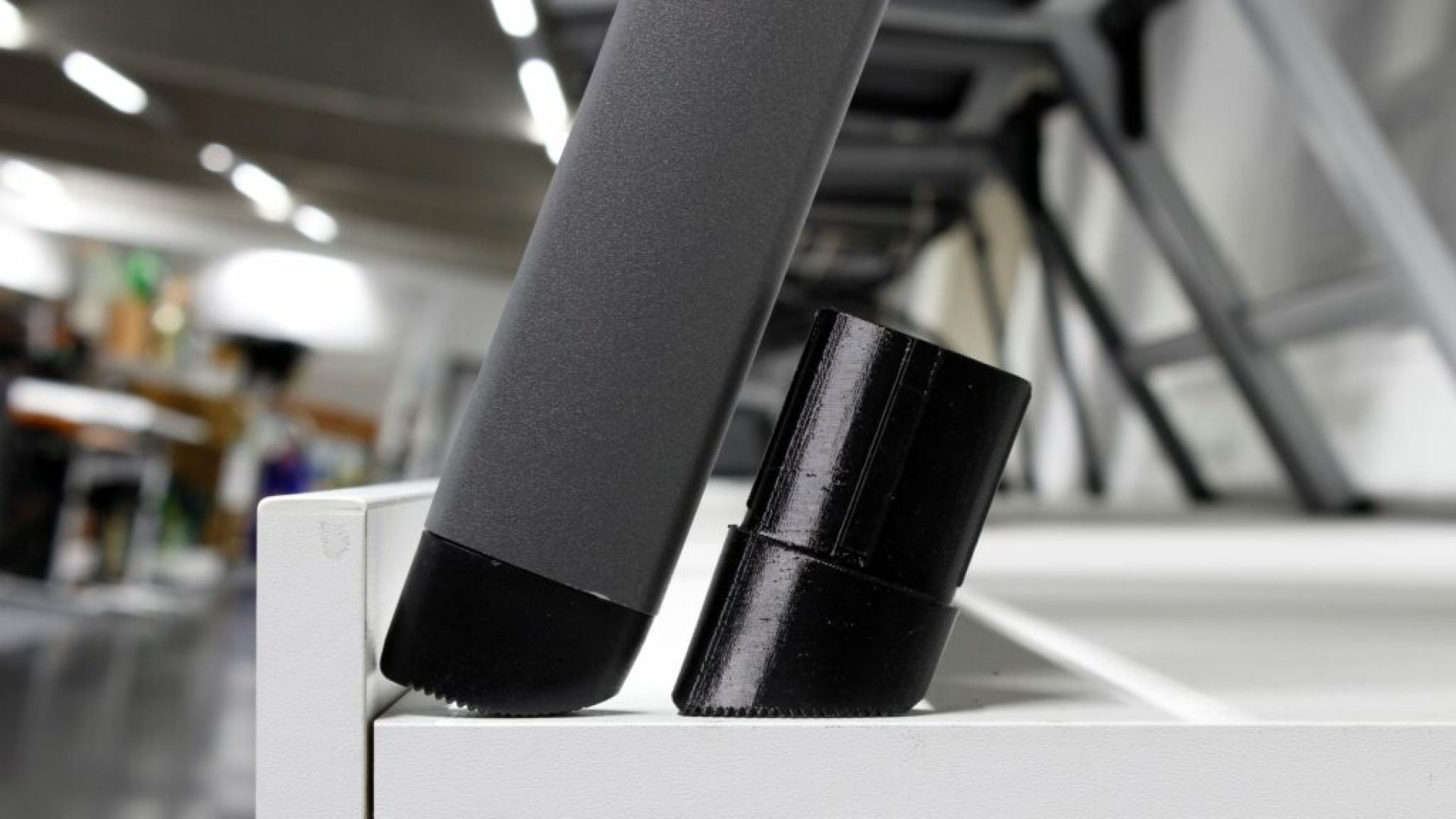
A real 3D-printed spare part from Siena Garden shows exactly how additive manufacturing can help: the Fofana foot cap. Without an alternative, the company would have had to discontinue this small but essential component once the product reached the end of its life cycle, purely on cost grounds. The result: customers would either have had to live with a chair missing its foot caps, or replace the whole piece of furniture – bad for customer satisfaction and sustainability alike.
A digital inventory combined with additive manufacturing changes that picture. Parts can be produced on demand, any time, because a single printer can produce practically any part suited to its technology without a costly changeover. Even a century from now, the foot cap would still be ready to print, since it stays permanently available in the digital inventory. Together with Replique, Siena Garden calls this concept the “Eternal Spare Part” – and by now, more than 1,000 of these 3D-printed foot caps are already in use.
How “eternal” spare parts work in practice
In practice, it starts with qualification: the part gets redesigned for 3D printing, and the right material, technology, and print parameters are locked in. Once the design is ready, it goes into the digital inventory – and from that point on, Siena Garden can offer the foot cap to customers as a permanently available spare part.
Siena Garden’s online shop is connected directly to that digital inventory. The moment a customer orders a spare part online, fulfillment is triggered automatically. A partner from Replique’s decentralized manufacturing network produces the part and ships it straight to the customer – a simple, lean process with no intermediate warehouse involved.
One trade-off remains: since additive manufacturing costs more than injection molding, the price of a foot cap rises noticeably, roughly threefold. Compared with buying an entirely new chair, though, that’s still a much smaller investment – and, more importantly, one that cuts waste and CO2 across the furniture’s whole lifetime, because it gets repaired instead of thrown away.
Meeting right-to-repair obligations
How confident are you that your spare parts will still be available in ten years?The sustainability benefits at a glance
| Factor | Conventional spare part production | Additive manufacturing |
|---|---|---|
| Availability after series end | Time-limited, depends on remaining stock | Practically unlimited, via digital inventory |
| Minimum order quantity | Often high, uneconomical for single parts | None, production from a batch size of one |
| Response to worn-out tooling | Costly re-manufacture of the mold required | No tooling needed |
| Effect on product lifecycle | Often forces premature end-of-life | Significantly extends useful life |
Taken together, additive manufacturing offers four key advantages during the use phase:
- It can cost-effectively expand the spare parts range even for the smallest quantities, following the REPAIR principle of the circular economy.
- Customized parts tailored to specific customer requirements become possible.
- Parts designed for 3D printing can be made lighter and stronger – in the transport sector, for example, that can noticeably cut fuel consumption.
- A product’s service life can be extended almost indefinitely, lowering its carbon footprint across the whole lifecycle while improving customer satisfaction and profitability.
FAQ
Why do many manufacturers eventually stop producing a spare part?
Because conventional manufacturing needs a minimum batch size to stay economical. As demand for a spare part tapers off near the end of a product’s life cycle, production stops paying for itself – especially if a mold would need to be remade.
What does REPAIR over REPLACE mean in the circular economy?
It means swapping out a defective part instead of discarding the whole product. Additive manufacturing makes that economically viable, since spare parts can be produced without a minimum order quantity and without new tooling.
What is an “eternal” spare part?
A part whose design is permanently stored in a digital inventory and can be printed on demand whenever it’s needed – a year from now or a century from now. There’s effectively no expiration date on its availability.
Why do 3D-printed spare parts cost more than the original?
Additive manufacturing has higher per-part production costs than injection molding, since there’s no tooling to amortize but every part is produced individually. For the Fofana foot cap, that premium is roughly threefold – still far cheaper than a whole new piece of furniture.
Regulation and real-world examples
What does the EU’s Right to Repair directive actually change?
It requires manufacturers of certain household appliances to offer repairs even after the legal guarantee has expired, and it explicitly prohibits them from blocking independent repairers from using 3D-printed or second-hand spare parts.
Are there real examples of additive manufacturing in the use phase?
Yes. Siena Garden offers the Fofana foot cap as an “eternal” spare part through Replique – more than 1,000 have been produced so far, keeping garden chairs in use instead of heading for disposal.