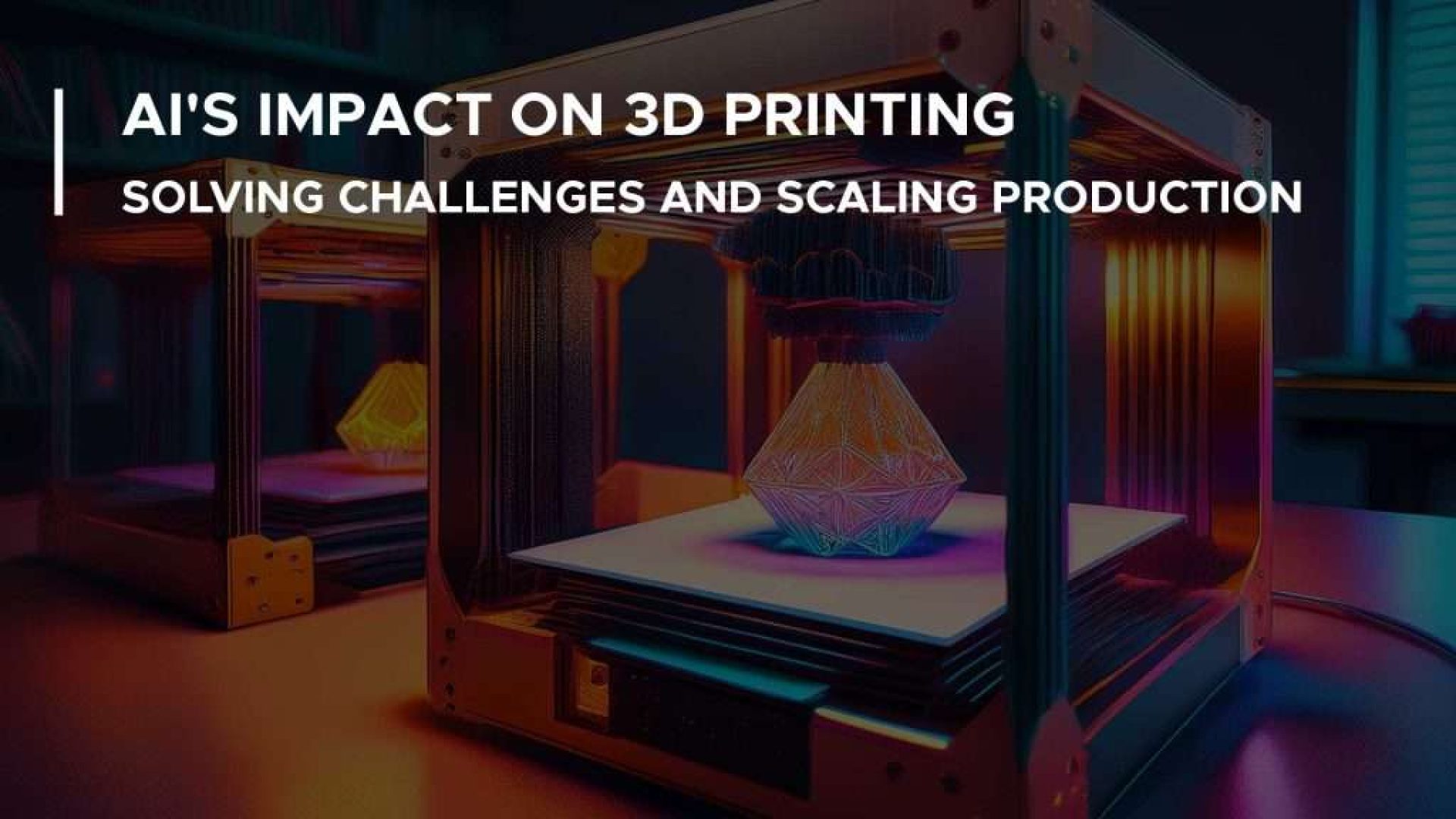
3D printing is growing fast, but growth alone doesn’t fix quality problems. Inconsistent material batches, warping, and defects that slip through cost time and money — especially when a part only gets rejected after it’s already printed. Artificial intelligence steps in exactly there: in process monitoring, in design, and in coordinating entire fleets of printers. Here’s what that looks like in practice, and where the limits still are.
How AI Is Making 3D Printing More Consistent
Catching defects before they happen
Warping, cracks, incomplete layers — in 3D printing, small variables decide whether a part succeeds or ends up as scrap: material batch, extrusion rate, part geometry. For a long time, the only real answer was trial and error, and problems often only showed up once the print job was already finished. This is where camera-based AI monitoring comes in. At SKZ – The Plastics Center, researchers built a camera system that watches the build plate during printing and flags typical failure patterns, such as so-called “spaghetti” errors, while the print is still running rather than after the fact.
Research teams are working on similar approaches to classify defects in polymer printing in real time: one recent study tested several AI models on a laser-sintering system to compare how reliably each one identified defects while parts were being built. Researchers at the University of Rostock are also investigating AI-based methods for catching quality deviations early in additive manufacturing. For especially sensitive applications like 3D bioprinting, a team led by Bianca Colosimo at Politecnico di Milano built a digital microscope with AI-driven analysis that compares each printed layer against the intended model and can automatically adjust parameters like material flow or print speed when something drifts off target.
AI turns quality control from after-the-fact troubleshooting into forward-looking process management — the difference between a part that gets rejected and one that never goes wrong in the first place.
| Criterion | Traditional quality control | AI-supported quality control |
|---|---|---|
| When defects are caught | After the print job is complete | While printing is in progress |
| Response to deviations | Manual adjustment for the next attempt | Automatic real-time parameter changes |
| Material waste | Entire part may be scrapped | Early stop or correction limits losses |
| Scaling across machines | Effort grows linearly with fleet size | Centralized monitoring across many machines |
What about your supply chain?
Let’s talk about consistent part quality in on-demand manufacturing.Generative Design: AI as a Creative Partner
Lightweighting that would be hard to achieve without AI
Traditional CAD tools were built for subtractive manufacturing and only translate loosely to additive processes. Generative design flips the workflow: engineers set load cases, weight limits, and material constraints, and the software proposes geometries a person would rarely arrive at from scratch — often organic-looking structures reminiscent of bone or honeycomb. Autodesk describes this approach as a way to preserve part strength while significantly cutting material use.
One example shows what that can mean in practice: a seat frame that Autodesk developed with an aircraft interiors manufacturer using generative design in Netfabb came out 56 percent lighter than comparable frames used in aircraft today — scaled up across a fully seated Airbus A380, the estimated fuel savings work out to roughly $100,000 a year. Examples like this help explain why analysts such as Grand View Research expect the software segment of the 3D printing market to grow fastest of all: the increasing integration of AI and machine learning into design, slicing, and monitoring software is seen as a key driver, with the overall market projected to grow from roughly $30.5 billion in 2025 to about $168.9 billion by 2033.
For design teams, that lowers the barrier to entry. Instead of running endless simulation loops by hand, the software handles most of the optimization and hands back several design options to choose from — putting sophisticated, weight-optimized parts within reach even for teams without dedicated generative-design specialists.
Scaling and Automating Production Workflows
Additive manufacturing has long since proven itself for prototyping and small batches. It gets harder when many machines, each with its own quirks, need to deliver consistent quality at high volume simultaneously. AI-driven automation coordinates print jobs across multiple machines, adjusts parameters per machine, and monitors progress centrally — with the goal of cutting down manual intervention and, with it, sources of error.
A survey of manufacturing executives across the US, UK, and Europe suggests manufacturers are taking this seriously: 82 percent of respondents now see AI as a central driver of growth for the industry, and roughly half already report measurable results in areas like supply chain management, procurement, or quality control — meaning these applications have moved well beyond pilot projects.
For industries with high-volume needs, such as consumer goods or automotive suppliers, this kind of consistency across many machines is exactly what makes AI-enhanced 3D printing economically viable at scale.
Multiple sites, one quality standard?
We’ll show you how our partner network makes that possible with on-demand manufacturing.FAQ
What’s the biggest advantage of AI in 3D printing?
The biggest lever is real-time quality control: AI catches deviations while printing is in progress rather than afterward, which cuts material waste and reduces scrap.
Can AI really detect defects in real time?
Yes. Camera-based systems and sensor analysis make it possible to identify typical failure patterns, such as layer shifts or excess material, while a build job is still running, as research at institutions like SKZ and the University of Rostock demonstrates.
Does AI-supported 3D printing make sense for small batches too?
Yes — even for prototypes and small runs, AI monitoring lowers the risk of costly failed prints. But its biggest economic impact shows up once multiple machines need to be coordinated in parallel.
Design and application
How does generative design work?
Engineers define targets such as weight, load, and material; the software generates several optimized geometry options based on those constraints, and a team selects and refines the one that fits best.
Does AI replace human design engineers?
No. AI handles the computationally heavy optimization and proposes options, but the final call on functionality, manufacturability, and cost still sits with the engineering team.
Which industries benefit most from AI in 3D printing?
Aerospace, automotive, and medical technology benefit the most, since precision and weight reduction directly affect cost and safety there. But the effects are increasingly visible in consumer goods and industrial spare-parts production too.
How does AI affect 3D printing costs?
Less scrap, fewer test prints, and lower manual monitoring effort bring down per-part costs, especially for larger production runs spread across multiple machines.