In the ever-evolving landscape of production and logistics, robotics and automation play an increasingly vital role, driven by the wave of digitization. However, as with any technology, there are also hurdles to overcome, especially when it comes to producing customized and lightweight parts in a cost-efficient manner. This is where 3D printing steps in. This article explores the benefits and diverse applications of 3D printing for robotic parts and looks at how the two technologies connect.
Understanding 3D Printing
Before exploring their interconnection, it’s worth understanding 3D printing, also known as additive manufacturing, itself. Additive manufacturing converts digital designs into tangible objects by building up material layer by layer. All that’s needed is the right design, and production can start without any huge production ramp-up. This freedom enables intricate designs, rapid prototyping, and on-demand production of customized parts, offering a level of flexibility and innovation that has redefined the manufacturing landscape.
Custom, Lightweight, and Consolidated Parts
Robotics is one of the industries where the benefits of 3D printing play a crucial role, and there are many reasons for that. One is the ability to create custom parts for robotics and automation machinery using 3D printing. Traditional manufacturing methods often fall short when it comes to creating parts, such as grippers, tailored to specific tasks, without incurring exorbitant costs from specialized tools and molds. Thanks to 3D printing, even small players (SMEs) can produce budget-friendly robot parts, since there’s no minimum order quantity, meaning production is possible from lot size one.
Weight is a critical factor in optimizing robotic performance. Traditional manufacturing often results in excess weight due to subtractive processes. 3D printing changes that by letting engineers design intricate, hollow structures that cut weight without compromising strength. This newfound agility finds applications in drones, exoskeletons, and various robotic systems.
The technical benefit of 3D printing also extends to consolidating multiple parts into a single, complex structure. That not only reduces overall weight but also cuts down on assembly work and inventory complexity. The reverse is possible too: 3D printing allows a single part to be split into distinct components, simplifying modifications later on.
Thanks to additive manufacturing, robot parts can be produced from lot size one, with no minimum order quantity and no expensive specialized tooling.
Looking for custom robotic parts?
We’ll show you how to optimize your components for 3D printing.Quick Prototyping and Design Changes
Compared to traditional methods, 3D printing offers unmatched agility in prototyping and design changes. Engineers and designers can quickly turn conceptual ideas into tangible prototypes and test them almost immediately to see if they’re a good fit. If they want to tweak or change the design, they can do that easily thanks to the flexibility of 3D printing. This doesn’t just speed up the product development cycle and shorten time-to-market considerably, it also fosters a culture of continuous improvement in the ever-evolving field of robotics.
Spare Parts On-Demand
The wear and tear faced by robotics and automation machinery can lead to costly downtime. Traditional ways of sourcing spare parts involve a time-consuming process of ordering, shipping, and, in some cases, custom manufacturing. 3D printing offers a rapid, cost-effective alternative: local or even on-site production of spare parts, just on-demand. Instead of waiting for shipments or relying on large inventories, robots can be back up and running quickly with 3D printed replacements, significantly minimizing downtime and keeping robots operational.
Application Examples
Grippers
Grippers in particular are undergoing a revolution thanks to additive manufacturing. It enables the creation of grippers in small volumes that are not only cost-efficient but also remarkably lightweight and optimized. When a gripper needs to be swapped out, 3D printing enables a fast process with short development and production times, translating into faster movements, reduced cycle times, and a more agile manufacturing process overall.
In a recent cooperation with struktur.form.design Engineering GmbH, Replique reduced the weight of a cobot gripper by 78%, part count by 84%, and overall production costs by 30%, just by redesigning the part and producing it via additive manufacturing. These figures were also picked up by The Robot Report.
These benefits extend beyond industrial automation, making a significant impact on healthcare robotics too. In surgical robots, for instance, 3D printed grippers can handle specialized instruments and carry out delicate tasks.
Embedded Sensors and Electronic Components
Beyond these core use cases, the collaboration between 3D printing and robotics opens up an even broader range of possibilities. Embedding sensors and electronic components directly into robotic structures using 3D printing, for example, enhances functionality and streamlines assembly.
Soft Robotics
For soft robotics, dealing with flexible and deformable structures, 3D printing opens up ways to create parts that move and adapt like real muscles. Researchers from Delft University of Technology, for instance, have pioneered 3D printing of soft robots using intricate viscoelastic hydrogels. These materials withstand high pressure and open up new possibilities in fields like medical prosthetics.
Innovation and Education
3D printing also serves as a catalyst for innovation and education in robotics. It fosters creativity among students and researchers, speeds up the learning curve, and drives advances in the development of robotic systems.
Downtime caused by missing spare parts?
Replique produces robotics spare parts on-demand through a decentralized partner network.Robots as 3D Printers
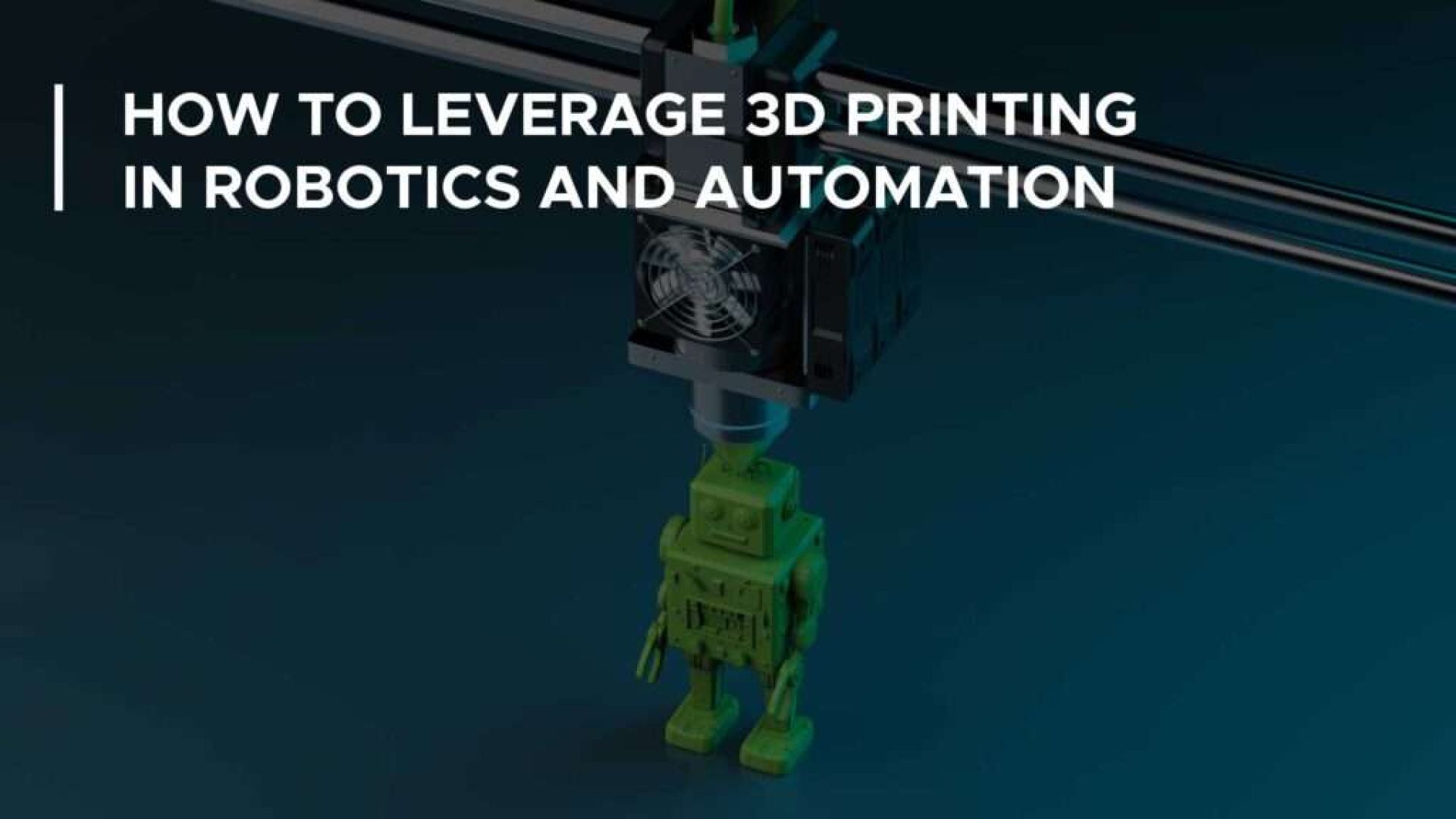
The relationship between robotics and 3D printing can even extend beyond conventional roles. Here, robots themselves become integral 3D printers, expanding the scope and scale of additive manufacturing. This is especially notable in large-scale 3D printing, where robotic arms deposit material layer by layer to create objects, making it possible to produce parts at a scale previously unattainable in 3D printing.
The intersection of 3D printing and robotics is reshaping how we conceive, design, and build robotic systems. From lightweight components to custom grippers and on-demand spare parts, this combination represents a real paradigm shift, offering tailored solutions that enhance the efficiency and adaptability of robotic systems.
FAQ
Why is 3D printing such a good fit for robotic parts?
3D printing allows for custom, lightweight, and complex parts without a minimum order quantity or expensive specialized tooling, which is ideal for the often small, specific volumes typical in robotics.
How does 3D printing help with spare parts for robotics and automation?
Instead of waiting on long lead times, spare parts can be printed locally, or even on-site, on demand. That significantly reduces costly downtime for robots and automation equipment.
How much weight can 3D printing save on a gripper?
In a cooperation with struktur.form.design Engineering GmbH, the weight of a cobot gripper was cut by 78%, with an 84% reduction in part count and 30% savings in production costs.
On Applications
Can robots 3D print themselves?
Yes. In large-scale 3D printing, robotic arms take on the role of the printer itself, depositing material layer by layer. That makes it possible to produce objects at a scale previously unreachable with conventional 3D printing, up to and including entire buildings.
Does 3D printing work for soft robotics too?
Yes, 3D printing enables the creation of flexible, muscle-like structures for soft robotics, for example using viscoelastic hydrogels developed by researchers at Delft University of Technology, opening up new applications such as medical prosthetics.
How does Replique support companies with robotics parts?
Replique connects companies, through a digital inventory platform, with a decentralized network of qualified 3D printing partners, enabling fast, cost-efficient production of custom robotic parts and spares.