Additive manufacturing for drones is no longer a prototyping curiosity — it is a production technology that UAV teams across every segment are actively deploying. Whether the application is last-mile delivery, infrastructure inspection, defence, or competitive racing, drone developers share the same hardware challenges: components need to be light, strong, and available quickly, often in quantities that make conventional manufacturing economics look entirely wrong. This article looks at what additive manufacturing for drones actually delivers, how it applies across four distinct UAV segments, and where CNC machining or other processes still make more sense.
- Why drones are a natural fit for additive manufacturing
- What additive manufacturing for drones actually delivers
- Commercial and delivery drones
- Industrial and inspection UAVs
- Defence and military UAVs
- FPV, racing, and hobby drones
- Choosing the right manufacturing process
- How Replique supports drone manufacturers
- FAQ
Why drones are a natural fit for additive manufacturing
The batch size problem
Most drone programmes do not produce at automotive volumes. A commercial delivery operator might be running a fleet of a few hundred aircraft. An industrial inspection company might have fifty. A defence programme might be procuring in batches of twenty or thirty at a time. These quantities sit in an awkward gap for conventional manufacturing: too small for injection moulding to make economic sense, too specialised for off-the-shelf catalogue sourcing to cover the full bill of materials.
On-demand manufacturing—whether additive or CNC—has no minimum order quantity and no tooling investment. Additive manufacturing for drones is particularly well suited to this gap: a motor mount, a payload bay, a custom sensor housing can each be produced in the quantity needed, when needed, without committing to a production run that sits in a warehouse.
Iteration speed
UAV hardware development moves faster than almost any other engineered product category. A design team might go through three or four significant airframe revisions in a year. Each revision means new physical hardware—and lead times of four to six weeks for machined parts, or minimum orders of thousands of units for moulded components, are simply incompatible with that pace. As the UAV market matures under EASA regulation, the pace of hardware development is only accelerating. Additive manufacturing for drones compresses the loop between a design change and a testable part to days—that is not a marginal improvement; it changes how teams work.
Weight is a continuous constraint
Every gram on a UAV is a gram that reduces payload capacity, flight time, or range. Additive manufacturing for drones—particularly via metal powder bed fusion—allows topology-optimised structures that remove material from wherever it is not structurally needed. Regulatory frameworks for UAS are pushing operators toward longer endurance and higher payload efficiency, which makes weight savings even more critical. The results can be dramatic: brackets and mounts that are 30–50% lighter than their machined equivalents, with equivalent or better structural performance.
The drone segment that benefits most from additive manufacturing is not necessarily the most advanced one. Across all four segments, the common thread is the same: small quantities, fast iteration, and the need for components that do not exist in any standard catalogue.
What additive manufacturing for drones actually delivers
Before looking at individual segments, it is worth being specific about what additive manufacturing for drones contributes in practice—beyond the general claim that it is faster and more flexible. There are five concrete advantages that come up consistently across UAV programmes.
Geometries that are impossible to machine or mould
Conventional subtractive manufacturing is constrained by tool access: a milling cutter cannot reach inside a closed cavity, and a mould cannot release a part with internal undercuts. Additive manufacturing has no such constraint. Internal cooling channels that follow the exact contour of a battery compartment, lattice-filled structures that are stiff in bending but remove material everywhere else, integrated snap-fits and cable routing channels that would require separate components if machined—all of these are straightforward to print and would be prohibitively complex or impossible by other means. For drone hardware, where thermal management and structural efficiency both matter, that geometric freedom is directly useful rather than a theoretical benefit.
Material selection matched to the application
The choice of material shapes the performance of a printed part as much as the geometry does. Carbon-fibre-filled nylons such as PA 603-CF are the go-to for rigid, ultra-lightweight airframe components where stiffness-to-weight ratio is the primary concern—delivering mechanical properties significantly above standard PA12 at equivalent weight. Parts that need dimensional stability across temperature cycles—electronics housings, sensor brackets, tight-tolerance interfaces—are better served by glass-sphere-reinforced grades such as PA 640-GSL, which maintain geometry more reliably. At serial volumes where surface quality and isotropic properties matter, HP PA 12 via Multi Jet Fusion provides consistent results across a batch. The right material depends on what the component actually needs to do—and getting that selection right upfront matters more than the process choice.
Part consolidation and reduced failure points
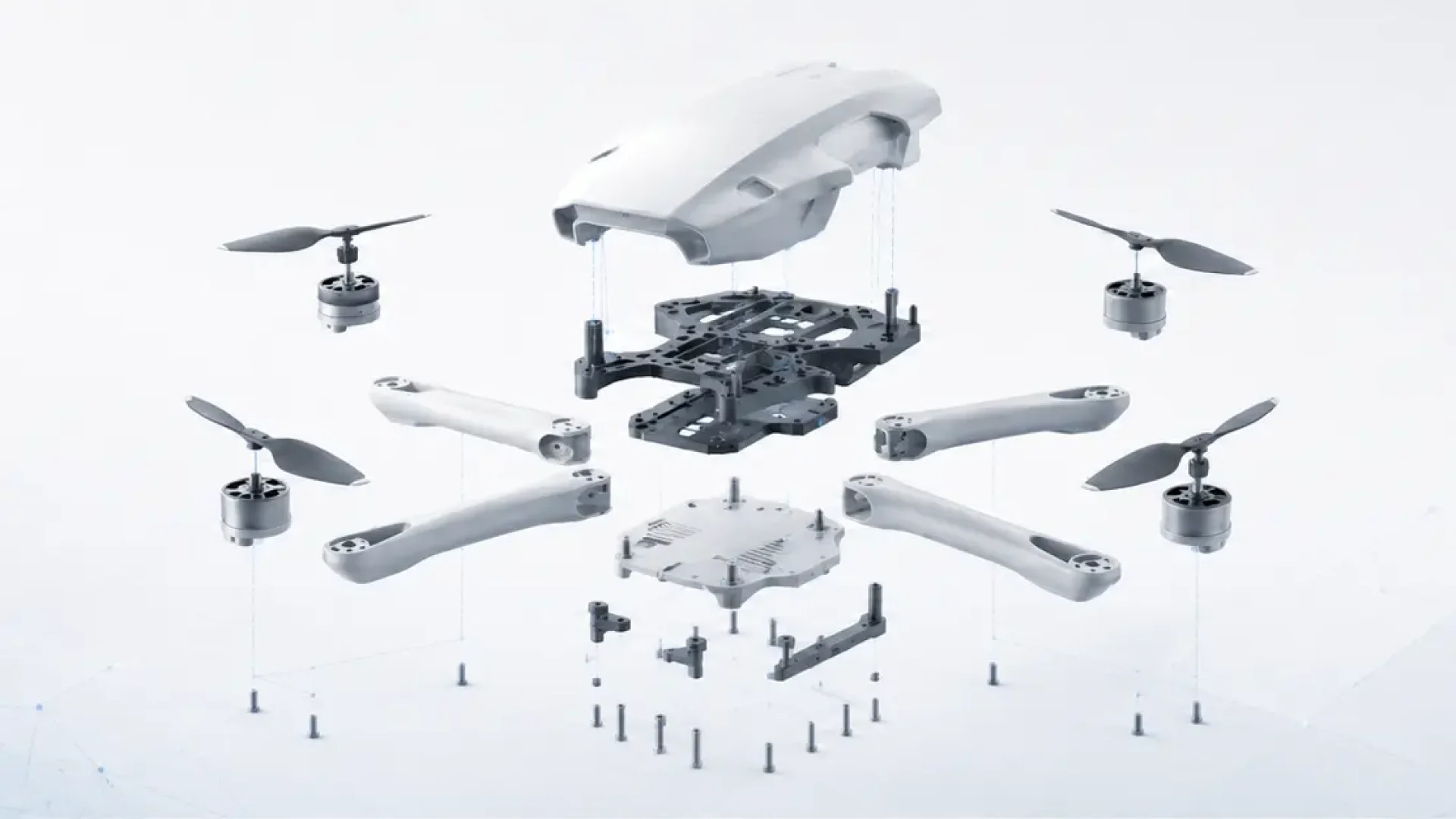
Drone assemblies built with conventional manufacturing accumulate parts: a motor mount is a separate bracket bolted to an arm, which is a separate extrusion joined to a centre plate. Each interface is a potential failure point, a source of vibration, a joint that can loosen under repeated stress. Additive manufacturing for drones allows those assemblies to be consolidated—a motor mount integrated directly into the arm, a cable channel built into a housing wall, a snap-fit latch produced as part of a cover rather than a separate clip. The result is a lower part count, less fastener weight, and a stiffer, more reliable structure.
Optimised aerodynamics and thermal management
Internal air channels and cooling ducts that follow the exact contours of electronics or battery compartments are one of the clearest examples of additive manufacturing enabling something that conventional processes cannot. A conformal cooling channel machined into a flat plate is a compromise; one printed to match the three-dimensional geometry of the component it is cooling is not. For high-performance UAV applications—extended endurance platforms, high-power propulsion systems, electronics that generate significant heat during operation—that difference translates directly into thermal performance during flight.
Rapid customisation without tooling investment
UAS requirements change faster than tooling can be produced. Integrating a new sensor payload means a new mount is needed. Mission profile changes call for different battery configurations, and customers requiring variant hardware face a tooling cost and weeks of lead time under conventional manufacturing. With additive manufacturing, the design is updated and the next batch reflects the change—no tooling, no minimum order, no months of lead time. When volumes eventually justify it, a design validated additively can be transitioned into injection moulding for cost-efficient scale production. The two approaches are complementary rather than competing.
On-demand digital supply chain
A digital parts library changes how spare parts work for drone fleets. Instead of holding physical inventory across multiple locations—inventory that ties up capital and becomes obsolete as designs evolve—component files are stored centrally and produced at a qualified partner when and where they are needed. For operators managing legacy fleets, that means continued availability of parts for platforms that are no longer in active production. For manufacturers supporting multiple customers, it means variant configurations can be maintained without physical stock. When demand spikes, production scales through the partner network rather than through a single facility.
The strongest argument for additive manufacturing in drone programmes is not any single one of these advantages. It is that all five apply simultaneously to the same component—a motor mount that is lighter, geometrically optimised, consolidates three parts into one, and can be revised next week if the design changes.
Commercial and delivery drones
The hardware challenge at scale
Commercial drone operators—delivery platforms, agricultural UAVs, passenger air taxis in development—are building towards operational scale but are not there yet. Most are in the phase of proving reliability, expanding their fleets incrementally, and continuously refining their hardware based on field experience. That phase is precisely where on-demand manufacturing is most useful.
Airframe structural components, payload bay housings, quick-release mechanisms, landing gear, and propulsion system mounts are all components that benefit from additive manufacturing in this segment. Designs change between production batches; operators need spares quickly when something breaks in the field; and the economics of carrying large physical inventories across a distributed fleet do not work. A digital parts library—files stored centrally and produced on demand at a partner near the point of need—addresses all three problems.
Regulatory context
Commercial drone operators in Europe work under the EASA UAS regulation and, for more complex operations, require type certification or operational authorisation. That introduces documentation requirements that are meaningfully higher than for experimental platforms. Parts produced for certified UAS need material traceability and process documentation—which a qualified manufacturing partner can provide, but which is worth specifying upfront rather than retrofitting.
Key components produced additively in this segment
- Airframe arms and structural frames in carbon-reinforced polymers or aluminium alloy
- Payload bay housings and quick-release interfaces
- Propulsion unit mounts and motor housings
- Battery enclosures with integrated thermal management features
- Landing gear and ground contact components
- Custom brackets and interface adapters for sensor integration
Building or scaling a commercial drone fleet?
We produce structural components, housings, and custom hardware on demand—in polymer and metal, with no minimum order and fast lead times worldwide.Industrial and inspection UAVs
A market defined by customisation
Industrial UAVs—platforms used for infrastructure inspection, surveying, agriculture, search and rescue, and environmental monitoring—are perhaps the segment where on-demand manufacturing has the clearest value proposition. Almost every deployment involves some degree of customisation: a specific sensor payload, a particular mounting configuration, an integration with ground equipment that requires a custom adapter. Standard catalogue parts rarely cover these requirements, and the volumes involved rarely justify custom tooling.
Inspection drone operators, in particular, deal with a recurring hardware challenge: platforms are operated in harsh environments, encounter impacts and wear, and need to be repaired quickly to keep operations running. The ability to produce a replacement arm, a broken payload mount, or a damaged housing within a few days—without waiting for an OEM spare parts order to arrive—has direct operational value.
Sensor integration as a driver
The payload is often the most valuable part of an inspection UAV, and integrating new sensors—thermal cameras, LiDAR units, multispectral imagers, gas detectors—requires custom mechanical interfaces that do not exist off the shelf. These mounts and adapters need to position the sensor precisely, manage vibration, and in some cases provide environmental protection. They are low-volume, geometrically specific, and often revised as sensor hardware evolves. Additive manufacturing handles all of that naturally.
| Application | Component need | Manufacturing approach |
|---|---|---|
| Infrastructure inspection | Camera and sensor mounts, replacement structural parts, vibration isolators | SLS polymer for mounts and housings; CNC aluminium for precision interfaces |
| Agricultural UAV | Spray nozzle brackets, tank mounts, custom boom configurations | SLS or MJF in chemical-resistant polymers; PP or PA12 for fluid-contact parts |
| Search and rescue | Payload release mechanisms, speaker or light mounts, ruggedised housings | DMLS stainless or aluminium for mechanisms; SLS polymer for housings |
| Surveying and mapping | LiDAR and GNSS antenna mounts, anti-vibration platforms | CNC aluminium for dimensional accuracy; SLS for rapid iteration on fit |
Defence and military UAVs
Speed and supply chain resilience
Defence UAV programmes have requirements that differ from commercial applications in two important ways. First, speed of procurement is often operationally critical—platforms need to be repaired, upgraded, or replaced on timescales that conventional supply chains cannot support. Second, supply chain resilience and sovereignty have become central procurement concerns, particularly for defence organisations looking to reduce dependence on single-region suppliers for critical hardware.
On-demand manufacturing through a certified global partner network addresses both. Damaged components can be reproduced and delivered within days. Design modifications driven by operational feedback—a new mounting point, a modified housing to accommodate an upgraded sensor—can be incorporated into the next production batch without retooling. Throughout all of this, the manufacturing footprint remains within a known, auditable supply chain.
Repair, maintenance, and field spares
For reusable military UAVs, the MRO requirement is significant. Platforms operated in demanding environments sustain damage and require replacement parts that may not be available through standard logistics channels at speed. A digital parts library—files stored securely and released for production on demand through a qualified network—enables field maintenance teams to get replacement hardware without waiting for central logistics. That capability is increasingly part of defence procurement discussions.
Defence procurement teams are increasingly asking suppliers for documentation of manufacturing location and supply chain traceability. On-demand manufacturing through a certified global partner network is a direct answer to that requirement—not an incidental benefit.
FPV, racing, and hobby drones
The segment that proved the technology
Before commercial and industrial drone manufacturers were printing production parts, the FPV and racing community was already doing it. The combination of high crash rates, continuous design iteration, small communities of pilots with specific preferences, and a culture of building and modifying hardware made desktop 3D printing the obvious tool—and it remains embedded in how this segment works.
For the hobbyist and semi-professional end of the market, desktop FDM printing handles most structural needs adequately. Frames, motor mounts, camera brackets, and antenna holders are printed in PLA, PETG, or TPU by pilots themselves or sourced from small online suppliers. The manufacturing barrier is low and the iteration speed is as fast as the designer wants it to be.
Where industrial processes add value at the high end
At the competitive end of racing and freestyle FPV—where performance margins are tight and component reliability matters—industrial additive manufacturing offers meaningful improvements over desktop printing. SLS nylon parts have better and more consistent mechanical properties than FDM equivalents. CNC-machined carbon fibre or aluminium components offer the stiffness and weight characteristics that matter in competition. For teams or small manufacturers producing hardware commercially, industrial processes also provide the consistency and documentation that resellers and buyers increasingly expect.
Choosing the right process for additive manufacturing for drones
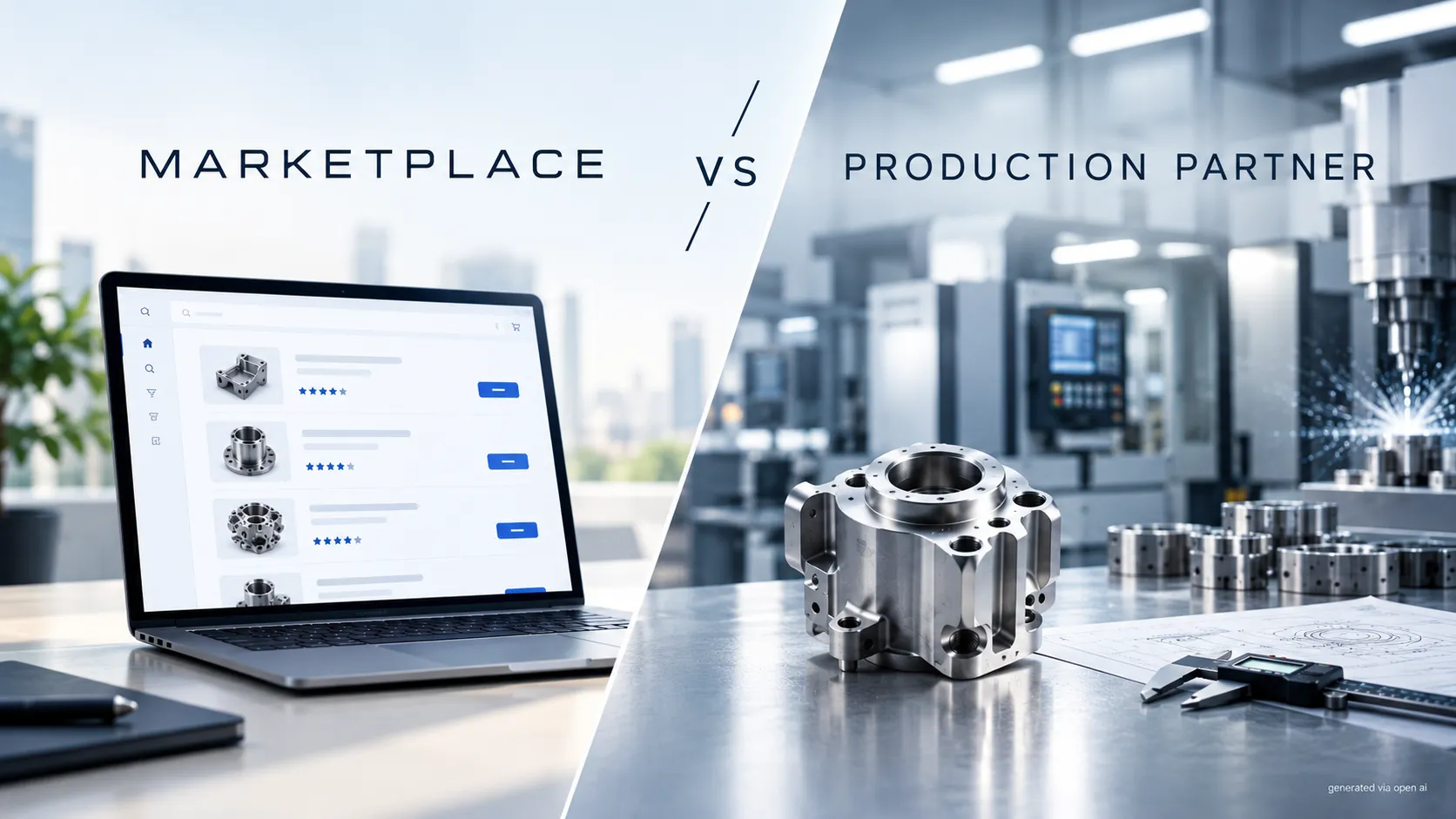
Across all four drone segments, the technology question comes up the same way: is additive manufacturing right for this drone component, or would CNC machining, sheet metal, or another process be better? The honest answer depends on the specific component, the required quantities, and the performance requirements. The table below gives a practical starting point.
| Component type | Recommended process | Reason |
|---|---|---|
| Airframe arms and frames (polymer) | SLS / MJF | Consistent mechanical properties, no tooling, good for small batches and iteration |
| Structural metal brackets and mounts | DMLS or CNC aluminium | DMLS for complex geometry or weight-optimised designs; CNC for simpler geometry requiring tight tolerances |
| Precision interfaces and bearing surfaces | CNC machining | Tight tolerances and fine surface finish are hard to achieve additively without significant post-processing |
| Sensor mounts and payload housings | SLS polymer or CNC aluminium | SLS for rapid iteration and complex geometry; CNC where dimensional accuracy is critical |
| Battery enclosures and electronics housings | SLS / MJF polymer | Complex geometry, thermal requirements, no minimum order |
| High-volume standard structural components | Injection moulding | At sufficient volume, moulding is faster and cheaper; additive economics improve below ~500 units |
| Propeller and rotor components | CNC or injection moulding | Aerodynamic surfaces require tight tolerances and surface quality that additive manufacturing rarely achieves without post-processing |
How Replique supports drone manufacturers
Process-agnostic manufacturing
Replique is a contract manufacturing platform. When a drone developer or operator brings us a component requirement, we do not default to additive manufacturing for drones as a blanket answer—we assess which process is right for that specific part, produce it through our certified global partner network, and provide full material and production documentation. There is no minimum order quantity for additive parts, and we can work from CAD files, physical samples, or technical drawings.
Digital parts management for drone programmes
For teams managing a growing component library across multiple drone variants, we can help structure a digital parts system: files stored centrally, production processes qualified, and parts released for on-demand production when needed. That approach works particularly well for operators managing field spares, for manufacturers supporting multiple customers with variant configurations, and for programmes that need to maintain parts availability over a long operational lifetime.
Where most conversations start
The most common starting point is not a technical question about manufacturing processes—it is a practical one: a part that is hard to source quickly, a custom component that does not exist off the shelf, or a production run too small for conventional manufacturing economics to make sense. If any of those describe your situation, it is worth a conversation.
Need a drone component that doesn’t exist in any catalogue?
We produce airframe parts, sensor mounts, housings, and custom hardware on demand—in polymer and metal, with no minimum order.FAQ
Can you produce parts for certified UAS that require documentation?
Yes. EASA’s UAS regulatory framework sets the documentation requirements for certified drone operations in Europe, and equivalent frameworks apply in other regions. For parts requiring material traceability and production documentation—relevant for EASA-certified UAS or defence programmes—we work with partners who provide full process records and material certificates. This needs to be specified at the enquiry stage so we can select the right partner and production process from the outset.
What materials work best for drone airframe components?
SLS nylon (PA12 or PA11) offers the best combination of mechanical properties, surface quality, and design freedom for polymer structural parts. Glass- or carbon-filled grades are available where particularly high stiffness or impact resistance is needed. Metal components—motor mounts, precision interfaces, structural brackets—are most commonly produced in aluminium AlSi10Mg via DMLS, with titanium available for weight-critical applications. Material selection depends on the operating environment, load requirements, and whether the part needs to meet any specific material specifications.
How quickly can replacement parts be produced for field repairs?
For polymer parts via SLS or MJF, typically three to seven business days from a validated file to delivery worldwide. For DMLS metal parts, seven to fifteen business days. CNC-machined components vary more by complexity. For operators with recurring field repair needs, we can pre-qualify parts and maintain production-ready files to reduce lead times on repeat orders.
Ordering, lead times, and files
Is there a minimum order quantity?
No minimum order for 3D printed parts—single units are fully economical. For CNC-machined components, small batches of five to ten pieces are generally feasible depending on setup complexity. If you regularly need one or two replacement parts at a time, additive manufacturing is almost certainly the right process for those components.
Can you help if we don’t have a CAD file yet?
Yes. For new designs we can work from sketches, drawings, or a description of the functional requirement. For replacement parts where no file exists, we can reverse-engineer from a physical sample. The effort depends on complexity—we are happy to assess a specific requirement before committing to a scope.