Quality is everything when it comes to producing parts, especially in series. Sectors like aerospace and automotive demand high standards and consistent part quality across every unit. As additive manufacturing keeps finding its way into more industrial applications, quality assurance (QA) has become one of the field’s biggest topics.
How do you define quality in a 3D printing process?
In injection molding, the mold itself does the work of repeatability – parts come out the same way every time, more or less by construction. In 3D printing, producers can’t fully guarantee a part’s quality until after it’s printed. The print process is long, shaped by many interacting parameters: printing speed, the amount of material deposited, fill and support structures, sintering time, layer height – the list goes on. On top of that come external factors: calibration, how materials are stored, maintenance, adhesives and print surface, the operator, even ambient humidity and temperature.
For additive manufacturing to work reliably, quality has to be repeatable and provable under matched conditions – same printer, same materials, same printing parameters. Three main risk areas determine the quality of a 3D printing process:
- The quality of the material resources and how they’re stored
- The quality of the manufacturing process itself
- Quality control after production
Materials as a quality factor
Every material manufacturer works from its own formula. Even for the same base material, each supplier adds its own additives and compounds, which means material properties can vary slightly from one manufacturer to the next. Quality requirements differ too – things like filament diameter control, powder particle homogeneity, or resin consistency. Materials of unknown origin or quality pose a real risk to a printed part’s final performance, especially for critical equipment or quality-sensitive products like medical devices or anything in contact with food.
For a 3D-printed Miele accessory that touches food – a coffee clip – we had to work with Forward AM, a BASF 3D Printing Solutions brand, to find not just a food-safe printing process but to adapt the entire production process to Good Manufacturing Practice (GMP), ruling out any external contamination.
Beyond how materials are made, how they’re stored matters just as much for part quality. Materials degrade over time if humidity, light, or temperature aren’t right. For traceability, we document material batch numbers at Replique – so if a quality issue turns up in one batch, we know exactly which parts were printed with it.
Quality starts with materials
How do you know your material actually meets the bar for your part?Assuring high quality in additive manufacturing
Setting up a manufacturing process that reliably produces quality parts is painstaking work. Unless a part is very simple, it takes an analysis of the geometry, the materials involved, and the development of qualified printing parameters. Depending on the design, some 3D printing technologies fit better than others.
In 3D printing, you often can’t copy an original part’s geometry one-to-one – and sometimes redesigning it actually leads to better part properties, less material use, and therefore less weight. Designing for 3D printing means thinking through things like wall thickness, part orientation in the build chamber, and avoiding sharp edges. A part that fails to print successfully can often be fixed with a fairly small geometric tweak.
Not every material used in conventional manufacturing exists in 3D printing – and even where it does, its properties can differ slightly (impact resistance, or properties that depend on the part’s orientation during printing, among others). Solid knowledge of additive manufacturing techniques and available materials is what it takes to find the best substitute for a conventional production material and land on successful print quality. Qualification plays a big role here too: any time material, process, or design changes from an already-approved conventional process, the part has to be retested to confirm quality and safe use.
Material manufacturers are often less advanced in additive manufacturing than 3D printing service bureaus are. That’s why it’s frequently the printing engineers inside a service bureau who work out the right printing parameters for a material – printing experience and prior work with that material decide whether the part ultimately gets printed with the right parameters and at high quality. And it’s not just the material: a part’s geometry shapes the printing parameters too, adding another layer of complexity.
So how does print quality stay repeatable across different locations if every manufacturer develops its own printing parameters? Repeatability is one of the core requirements for qualified serial production. At Replique, we solve this by enforcing printing parameters directly on our platform: a producer in our network can only fulfill a customer order using the printing parameters that were defined and locked in beforehand.
| Factor | Conventional serial production | Additive manufacturing |
|---|---|---|
| Repeatability | Built into the tooling/mold itself | Depends on many interacting printing parameters |
| External influences | Low | Calibration, storage, humidity, operator, and more |
| Quality control | Established industry-wide | Inconsistent, often looser for non-critical parts |
| Traceability | Established via batch tracking | Depends on the provider; automated at Replique |
Repeatable print quality
How many different sets of printing parameters are floating around for your parts right now?Why every part needs quality control
Conventional manufacturing processes come with established quality control, from manual inspection to destructive or non-destructive testing. In additive manufacturing, though, the parts coming off each printer are constantly shifting, and lot sizes run much smaller than in conventional manufacturing. That’s why some producers of non-critical 3D-printed parts, without high quality requirements, still skip strict quality control processes.
But additive manufacturing has stopped being just a developing technology. It’s moved from mostly prototyping and a handful of high-value industries (aerospace among them) to a mature stage where it’s becoming standard across virtually every industrial sector. That makes it all the more important to adopt the technology responsibly, with quality control firmly in view.
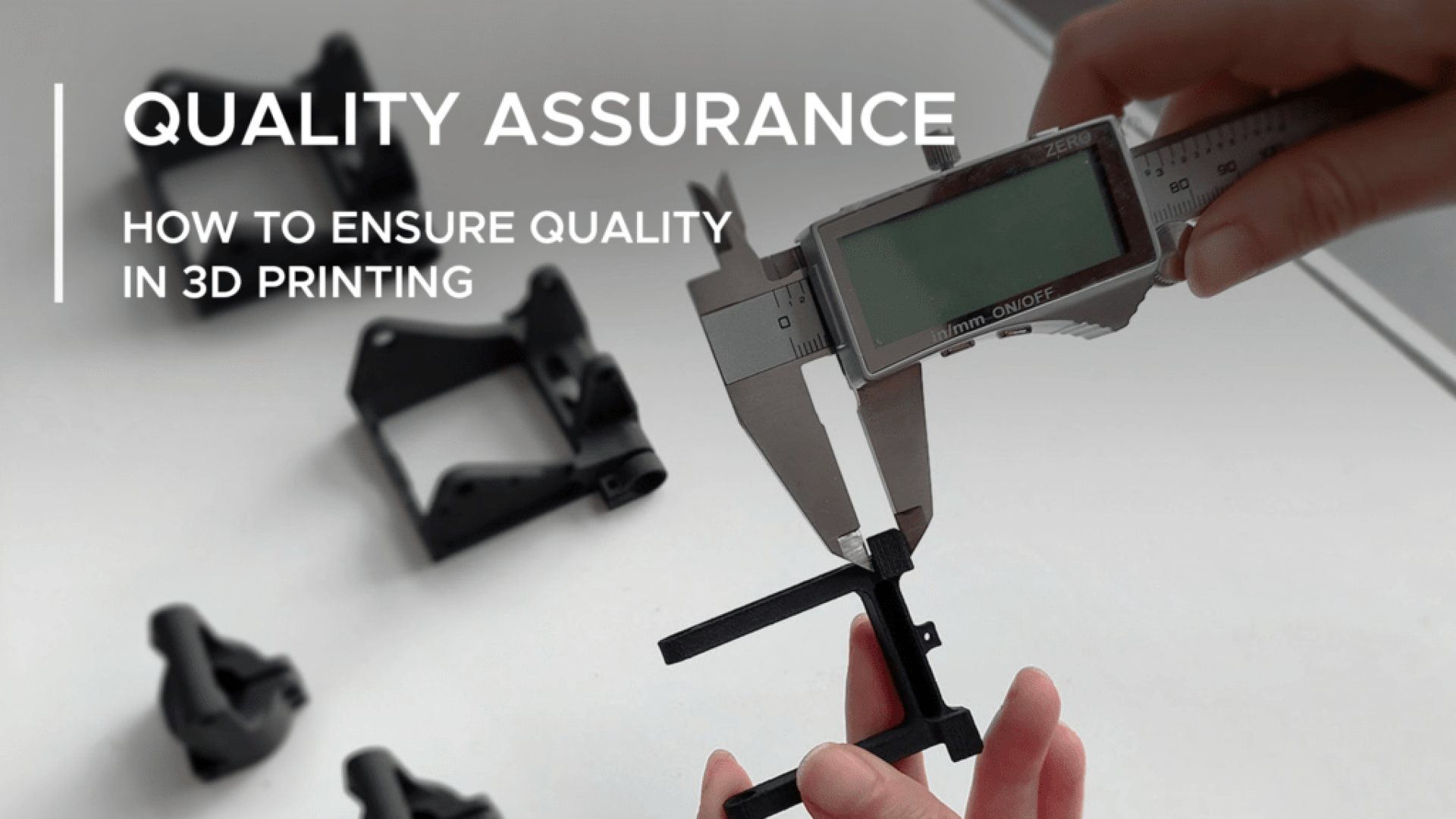
Quality inspection is a core piece of getting this right. At Replique, we focus on visual inspection, dimensional measurements, weighing parts, and photo documentation. When something’s off, we and our printing partners correct it together – by adjusting printing parameters, switching materials, trying different post-processing, or even tweaking the part’s geometry.
For more critical parts, applying formal standards matters even more. Quality documentation is what keeps every additively manufactured part on record. At Replique, we attach an automated quality report to every spare part – digital documentation that cuts down manual effort and permanently stores the information behind every part produced.
FAQ
Why is quality assurance harder in 3D printing than in injection molding?
Because in injection molding the mold itself enforces repeatability, while in 3D printing many interacting parameters – from print speed to ambient humidity – shape the outcome. That means quality can only really be judged after the part is printed.
What three risk areas determine quality in 3D printing?
The quality of the material resources and how they’re stored, the quality of the manufacturing process itself, and quality control carried out after production.
Why do material properties differ between manufacturers?
Every material manufacturer uses its own formula, with different additives and compounds even for the same base material. That means mechanical properties can vary slightly even when a material looks identical on paper.
What does requalification mean in 3D printing?
Whenever material, process, or design changes from an already-approved setup, the part has to be retested to confirm that quality and safe use are still guaranteed.
Quality control in practice
How does Replique ensure repeatable print quality across different locations?
By locking printing parameters directly into the platform: a production partner in Replique’s network can only fulfill an order using the parameters that were defined and approved beforehand.
What inspection methods are part of quality control for 3D-printed parts?
Typically visual inspection, dimensional measurements, weighing the part, and photo documentation – with more critical parts getting additional, part-specific inspection standards on top.
Why does batch traceability for materials matter?
Because if a quality issue turns up in a material batch, it lets you pinpoint exactly which parts were printed with it – without batch documentation, that’s nearly impossible to reconstruct after the fact.