
A container ship crosses an ocean. A warehouse holds parts nobody has ordered yet. A pallet flies in overnight because a machine went down nearby. Sustainable manufacturing has to deal with all of this before a single part reaches the factory floor. Local and on-demand production tackles these emissions at the source — not as a marketing add-on, but as a direct result of how and where parts get made. This article shows where those emissions come from, what sustainable manufacturing looks like in practice, and how manufacturers are cutting CO₂ in their sourcing decisions without losing reliability or control over cost.
- Where manufacturing emissions actually come from
- What sustainable manufacturing delivers for CO₂ reduction
- Spare parts and MRO
- Low-volume and end-use production
- Tooling, jigs, and fixtures
- Reshoring and supply chain redesign
- Measuring sustainable manufacturing impact
- How Replique supports sustainable manufacturing
- FAQ
Where manufacturing emissions actually come from
Transportation is a bigger lever than most manufacturers assume
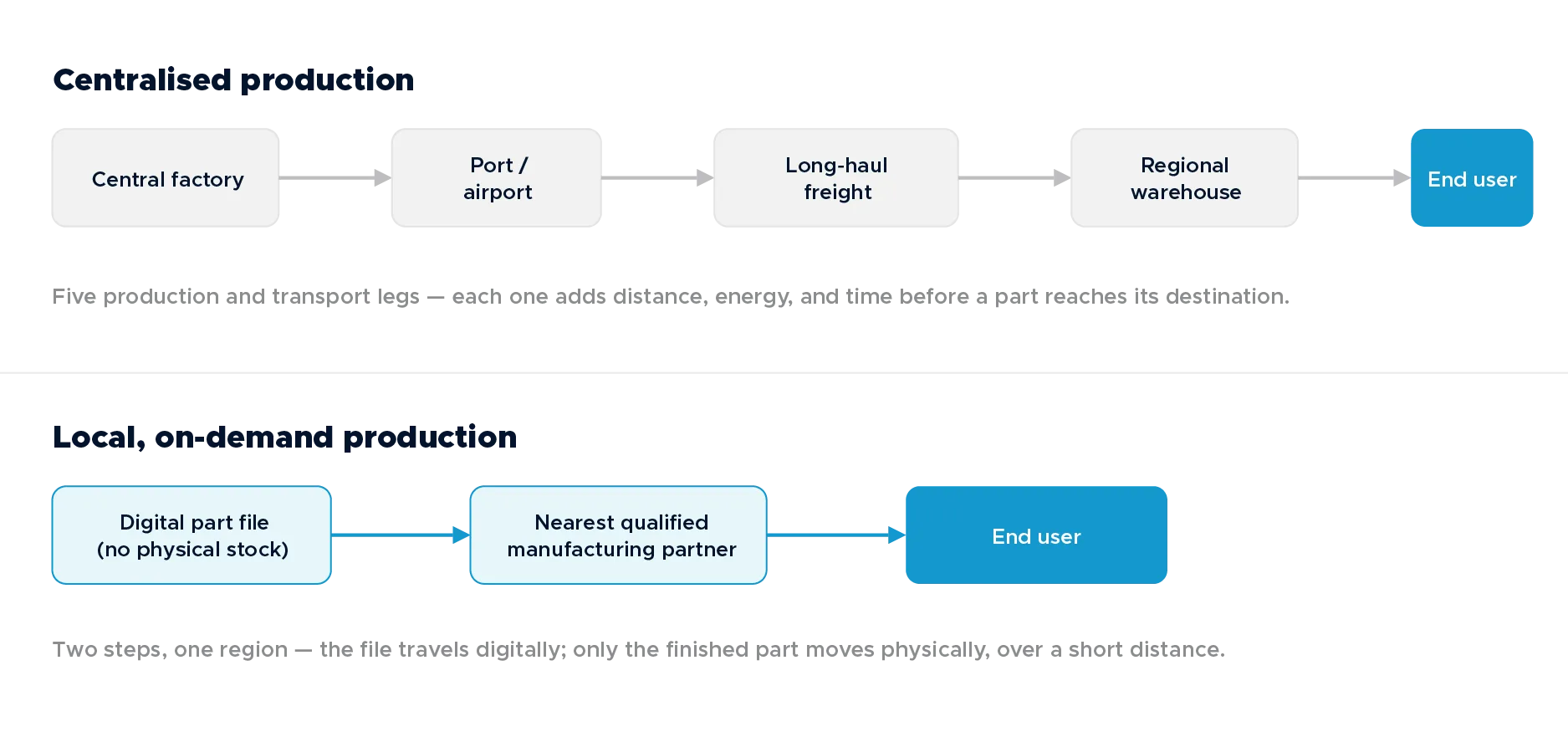
A part made in one region and shipped to another picks up emissions at every leg of the journey. It travels from factory to port, crosses by ocean or air freight, moves from port to distribution centre, and finally reaches the end customer. Sea freight is relatively efficient per kilogram for heavy industrial components. That efficiency disappears the moment a shipment needs to move by air, and it disappears again for the long tail of low-volume, high-mix parts that ship individually instead of in consolidated container loads. The International Energy Agency’s analysis of industrial energy use flags logistics and distribution as a meaningful, often underestimated share of a product’s total footprint. Producing a part closer to where it will actually be used removes several of those legs entirely.
Overproduction and inventory are emissions, not just cost
Traditional manufacturing economics push toward large batch sizes. Tooling and setup costs are fixed, so spreading them across more units lowers the cost per part. That logic fills warehouses with components nobody may ever need in the quantities produced. When a design changes, a product line gets discontinued, or demand never materialises, those parts get scrapped — carrying the full emissions footprint of their production and transportation for zero end use. Warehousing itself is not emissions-free either: heating, cooling, lighting, and material handling all add up across a facility holding inventory for months or years.
Tooling is a hidden carbon cost
Manufacturers typically machine injection moulds, stamping dies, and jigs from large blocks of tool steel or aluminium — an energy- and material-intensive process that happens before a single production part exists. When a design changes or a production run gets cancelled, that tooling often ends up scrapped or sitting unused, along with the emissions embedded in making it. The European Commission’s circular economy framework increasingly treats this kind of stranded manufacturing investment as a material efficiency issue, not just a cost one.
None of these emissions sources are exotic or hard to identify. Transportation, overproduction, idle inventory, and stranded tooling are well understood inefficiencies. Local, on-demand production now offers a practical way to address all four at once, without forcing manufacturers to choose between sustainability and reliability.
What sustainable manufacturing delivers for CO₂ reduction
People often claim that local production reduces emissions, but they rarely back it up. The mechanisms are worth spelling out — five concrete effects that show up consistently when manufacturers move from centralised, forecast-driven production toward a distributed, on-demand model of sustainable manufacturing.
Shorter transport distances, fewer transport modes
Producing a part at a site close to the point of use removes the long-haul freight leg almost entirely, instead of shipping it globally from one central facility. It also removes the need for air freight as an urgent fallback. A global partner network can produce a part ordered in Southeast Asia in Southeast Asia, and a part ordered in Central Europe in Central Europe — rather than shipping both from a single hub on another continent.
No overproduction, because nothing gets made speculatively
On-demand manufacturing produces exactly the quantity ordered, whether that’s one part or one hundred. It skips the forecast-driven batch sized purely to justify tooling costs. That removes the emissions tied to units nobody ever uses, and it removes the storage footprint of holding surplus inventory in a warehouse indefinitely.
Digital inventory instead of physical inventory
A digital parts library replaces a physical warehouse with a set of qualified, production-ready CAD files. Nothing gets manufactured, stored, heated, cooled, or eventually scrapped until an order actually exists. For manufacturers managing thousands of spare-part variants across long product lifecycles, this is often the single largest lever for CO₂ reduction in manufacturing — inventory that used to sit as physical stock across several regional warehouses simply stops existing until someone needs it.
Material efficiency through additive processes
When additive manufacturing is the right process for a part, it typically uses only the material that ends up in the finished component, plus reusable powder in processes like SLS or MJF. It skips the step of starting from a solid billet and machining away most of it as swarf. For parts where subtractive processes remain the better choice — tight-tolerance metal components, precision interfaces — routing production to the nearest qualified partner still captures the transportation and inventory benefits, even where the material-efficiency benefit doesn’t apply.
No stranded tooling investment
On-demand production has no minimum order quantity, so there’s no tooling to build, retool, or discard when a design changes. A revised part simply comes from the updated file at the next order. For manufacturers iterating on product design or managing parts through multiple engineering revisions, this removes an entire category of embedded-carbon waste that conventional mass production treats as unavoidable.
The strongest case for sustainable manufacturing doesn’t rest on any single mechanism. It rests on applying all five to the same part at once — produced close to where it’s needed, in the exact quantity ordered, from a digital file rather than a warehouse shelf, using a material-efficient process where possible, with no tooling left behind when the design moves on.
Economic sustainability matters just as much
Sustainability isn’t only about emissions. For any company, economic sustainability — staying financially healthy enough to keep operating, investing, and competing — matters just as much, and in most boardrooms it matters more. Manufacturers rarely get to choose between the environmental case and the financial case; both have to hold up at the same time. What makes local, on-demand production worth the conversation is that the two rarely pull in opposite directions here. Less capital tied up in warehoused inventory, no tooling scrapped when a design changes, and shorter, cheaper freight routes cut cost and carbon in the same move. It’s one of the few sourcing decisions where the sustainable choice and the economical choice tend to line up on both sides of the balance sheet.
Spare parts and MRO
The segment with the clearest emissions case
Spare parts and maintenance, repair, and overhaul (MRO) components show the clearest, most immediate sustainability impact of any segment. Industrial equipment, machinery, and vehicle fleets often stay in service for decades, so manufacturers have to guarantee parts availability long after the original tooling has retired or the original supplier has exited the business. Under a conventional model, that guarantee means holding physical stock — sometimes for parts ordered only once every few years.
A digital parts library replaces that stock with files a qualified site near the customer can produce on demand, only when an order actually exists. For OEMs running long-tail spare parts catalogues with thousands of part numbers, this shift cuts warehousing footprint, obsolete inventory write-offs, and long-haul emergency freight substantially.
Reducing emergency air freight
Unplanned equipment downtime creates strong pressure to get a replacement part on-site fast, regardless of the emissions cost — which is exactly what pushes teams toward air freight from a distant central warehouse. Producing the part at a local partner instead removes both the urgency premium and the freight emissions in one step, usually without the multi-day wait that international emergency shipping still involves.
Managing a long-tail spare parts catalogue?
We help manufacturers move physical spare parts inventory into a digital library, produced on demand at a qualified partner near the point of need.Low-volume and end-use production
Where batch size determines the sustainable choice
For genuinely high-volume, stable-design components, mass production with established tooling still wins on a per-part basis — the emissions of a mould amortise across enough units that on-demand production doesn’t necessarily beat it. The picture changes for the large and growing share of industrial components produced in low or variable volumes: regional product variants, customer-specific configurations, niche or short-lifecycle products, and parts early enough in their lifecycle that demand hasn’t stabilised yet.
For these components, on-demand production skips the batch-sizing decision altogether. Parts get made to match actual orders, which tracks real demand far more closely than any forecast-driven production run can.
| Production scenario | Emissions driver under conventional sourcing | Effect of local, on-demand production |
|---|---|---|
| High-volume, stable design | Well amortised tooling; freight is main variable | Regionalised production still cuts transport emissions; tooling case is neutral |
| Low-volume or variant-heavy production | Oversized batches, high scrap rate, stranded tooling | Produced to exact order quantity; no tooling built or discarded |
| Long-tail spare parts | Physical warehousing, obsolescence write-offs, emergency freight | Digital inventory; produced locally only when ordered |
| Prototyping and pre-series | Short-run tooling built and scrapped repeatedly across iterations | No tooling required per iteration; design changes cost nothing to implement |
| Regional product variants | Central production, then shipped to each region | Each variant produced at the regional partner closest to that market |
Tooling, jigs, and fixtures
Removing embedded carbon from indirect production equipment
Jigs, fixtures, gauges, and assembly-line tooling aren’t end-use products, but they carry a real manufacturing footprint. Teams often produce them, use them briefly, and discard them the moment a production line gets reconfigured. These components rarely need the surface finish or long-term durability that would justify machining from solid stock, and teams typically produce them in single units or very small batches — a profile that suits on-demand manufacturing, particularly additive processes, well.
Manufacturers running frequent line changeovers or supporting several product variants on the same line increasingly produce this category of hardware on demand, rather than stocking fixtures for configurations they may never need again. The direct effect is a smaller footprint per fixture; the indirect effect is that faster, cheaper fixture production makes frequent process improvement more attractive, which compounds over time.
Reshoring and supply chain redesign
Sustainability and resilience are converging
Cost, lead time, and geopolitical risk have historically driven reshoring and nearshoring decisions — not emissions. But all three considerations now point in the same direction. A supply chain redesigned to reduce dependency on a small number of distant production hubs, for resilience reasons, very often ends up with a smaller transportation footprint too. ISO 14001 environmental management standards increasingly come up alongside supply chain resilience criteria in procurement decisions, reflecting how closely the two considerations have become linked in practice.
A distributed, on-demand manufacturing network gives manufacturers a practical way to act on this convergence without one disruptive relocation of production. Rather than moving an entire supply chain at once, a manufacturer can route individual part families to the nearest qualified partner as demand arises, building toward a more regionalised footprint step by step.
Procurement teams increasingly ask for carbon reporting and supply chain resilience documentation in the same conversation. A distributed, on-demand manufacturing network is one of the few sourcing changes that answers both questions with a single underlying decision.
Measuring sustainable manufacturing impact
What you can realistically quantify
Some sustainability benefits of local, on-demand production are easier to quantify than others. You can estimate transportation emissions avoided by producing closer to the point of use fairly well from distance and freight mode. Emissions avoided by skipping surplus inventory are harder to pin down precisely, but you can approximate them from historical scrap and write-off rates. Material efficiency gains from additive processes versus subtractive machining are measurable directly by comparing material input to finished part weight.
Manufacturers building sustainability reporting around their sourcing decisions generally get the most reliable numbers by tracking these components separately, rather than blending them into one “CO₂ saved” figure. Being explicit about the comparison baseline matters too — a genuinely avoided air freight shipment represents a very different saving than a marginal cut in ocean freight distance.
Where local production isn’t automatically the lower-carbon choice
Local and on-demand production isn’t a universal rule. A part produced locally on a carbon-intensive regional energy grid, using an inefficient process, can carry a larger footprint than the same part produced centrally on a cleaner grid and shipped efficiently by sea in a consolidated shipment. The emissions case depends on the specific combination of process, energy source, transport mode, and volume — which is exactly why a process-agnostic approach, evaluated part by part, beats a blanket “always local” or “always on-demand” policy.
How Replique supports sustainable manufacturing
A distributed, process-agnostic network
Replique operates a certified global partner network spanning additive manufacturing, CNC machining, and other production processes. When a manufacturer brings us a part or a catalogue of parts, we route production to the qualified partner best positioned to serve that specific requirement. In practice, that usually means the partner closest to where the part will actually be used, using whichever process genuinely fits — not whichever technology we’d default to.
Digital inventory as the operational foundation
Moving spare parts, tooling, and low-volume production files into a digital library is the practical first step for most manufacturers pursuing sustainable manufacturing at scale. We qualify files once, store them centrally, and release them for production on demand at whichever network site sits closest to the order — removing physical inventory, stranded tooling, and unnecessary freight from the picture, without requiring a manufacturer to redesign their entire supply chain at once.
Where most conversations start
Sustainability targets usually aren’t the first thing that brings a manufacturer to this conversation. A spare parts warehouse that’s become too expensive to maintain, a sustainability report that needs harder numbers behind it, or a supply chain resilience review that surfaces the same inefficiencies — one of those usually is. If any of that sounds familiar, it’s worth a conversation.
Looking to reduce the footprint of your parts supply chain?
We help manufacturers move toward local, on-demand production — with full material documentation and no minimum order quantity.FAQ
What does sustainable manufacturing mean in an industrial context?
In an industrial context, sustainable manufacturing means reducing the environmental footprint of how and where parts get made — not just what they’re made of. That includes cutting transportation emissions, avoiding overproduction, reducing idle inventory, and eliminating tooling that gets scrapped before it delivers value. Local, on-demand production addresses all four directly, which is why it has become a core strategy within sustainable manufacturing rather than a niche add-on.
Does on-demand production actually reduce CO₂ emissions, or is it just a cost-saving model with a sustainability label attached?
Both effects are real and usually aligned, but they aren’t the same thing. Cost savings come mainly from removing tooling and inventory carrying costs; emissions savings come from removing transportation, overproduction, and stranded-tooling sources. The two align closely in most low-volume and spare-parts scenarios, which is part of why the model has gained traction. Still, a manufacturer reporting on sustainability impact should quantify the emissions case separately rather than assume cost savings imply an equivalent carbon reduction.
Is 3D printing always more sustainable than CNC machining or injection moulding?
No. Additive processes are typically more material-efficient for complex, low-volume geometries, but injection moulding stays more resource-efficient per part at high, stable volumes once tooling is amortised. CNC machining remains the right choice for precision metal components regardless of sustainability considerations. The sustainable choice depends on volume, geometry, material, and location, which is why we assess each part rather than default to a single process.
Can you provide documentation for sustainability or ESG reporting?
Yes. For manufacturers building supplier-level carbon reporting into their ESG disclosures, we can provide production location data and process information to help estimate transportation and production-related emissions for parts produced through our network. Specify this at the enquiry stage so we can set up the right reporting format from the outset.
Getting started
Do we need to move our entire parts catalogue at once?
No. Most manufacturers start with a specific category — typically slow-moving spare parts or a variant-heavy product line — qualify the production process and partner network for that category, and expand from there once the model proves out. Migrating a full catalogue in one step is rarely the practical starting point.
What information do you need to assess the emissions case for our parts?
We need current sourcing locations, shipping destinations, order frequency and volume per part, and current production process. From there, we can give you a realistic comparison between your current sourcing model and a distributed, on-demand alternative for the specific parts in question.