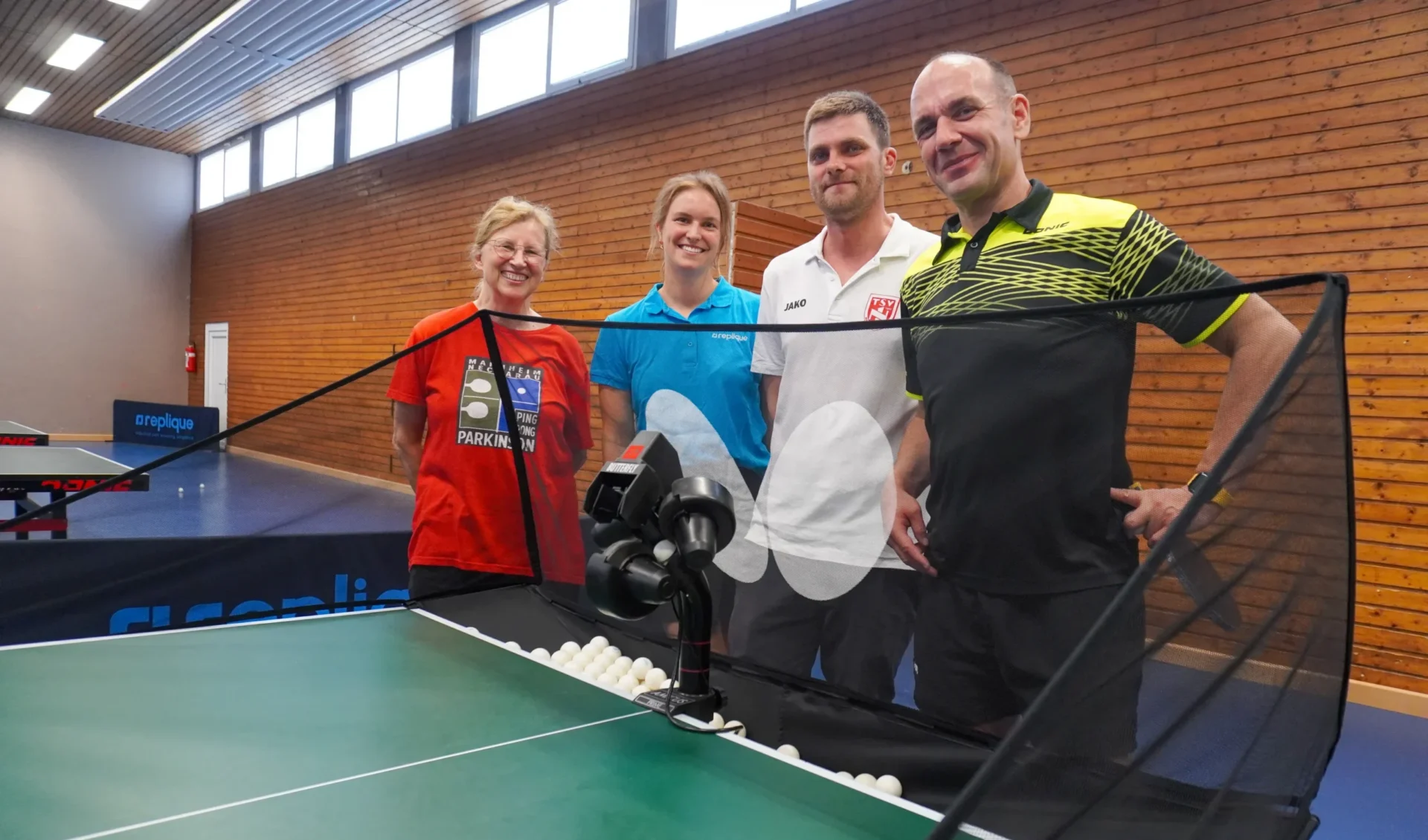
We were at Future Labs Basel in May 2026, and two topics came up constantly: the growing role of 3D printing in pharma and biotech environments, and the shortage of custom lab consumables that actually fits the workflows teams are trying to automate. Both are practical problems, not future concepts—and both point toward on-demand manufacturing as a more realistic answer than most catalogues currently offer.
What we heard on the floor
More operational than previous years
Future Labs Basel has become a key meeting point for lab managers, procurement teams, and engineers from pharma, biotech, chemical, and diagnostics companies across Europe. In contrast to previous editions, the 2026 event felt notably more grounded—less concept, more operational reality. Rather than exploring what the lab of the future might look like in ten years, most attendees arrived with concrete problems to solve today.
Interestingly, the range of those problems was wider than you might expect. Yes, spare parts and equipment availability came up frequently. However, so did much more everyday challenges: how do you get custom lab consumables that fits a specific robot gripper? How do you prototype a new sample rack quickly enough to keep up with process development? How do you equip five lab benches identically when the standard catalogue part is just slightly wrong for your workflow? These are not dramatic supply chain crises—rather, they are the low-level friction that labs deal with constantly, and that quietly slows things down.
3D printing pharma: shifting from prototype to production tool
One theme in particular stood out across multiple conversations: 3D printing in pharma environments is no longer being evaluated as a prototyping technology. Instead, teams are asking which production applications make sense, which processes meet their material and documentation requirements, and how to qualify a manufacturing partner. That shift in framing—from “can we try it?” to “which parts does it make sense for?”—is a meaningful one.
A visible shift toward modular, dedicated processes
Beyond the supply chain conversations, our team also noticed a clear trend in how labs are being designed and run: a move away from large, multi-purpose platforms toward smaller, modular setups with dedicated processes. Rather than one instrument handling everything, labs are increasingly combining specialised units that each do one thing well. That modularity creates more flexibility—but it also multiplies the number of custom interfaces, holders, and adapters needed to make everything work together. Which, in turn, makes the case for on-demand manufacturing of custom lab consumables even stronger.
The most common frustration at Future Labs Basel was not a lack of technology. Instead, it was the gap between what automation systems can do and what the custom lab consumables around them actually support.
Custom lab consumables: the part nobody has in stock
Why improvised solutions are everywhere in pharma labs
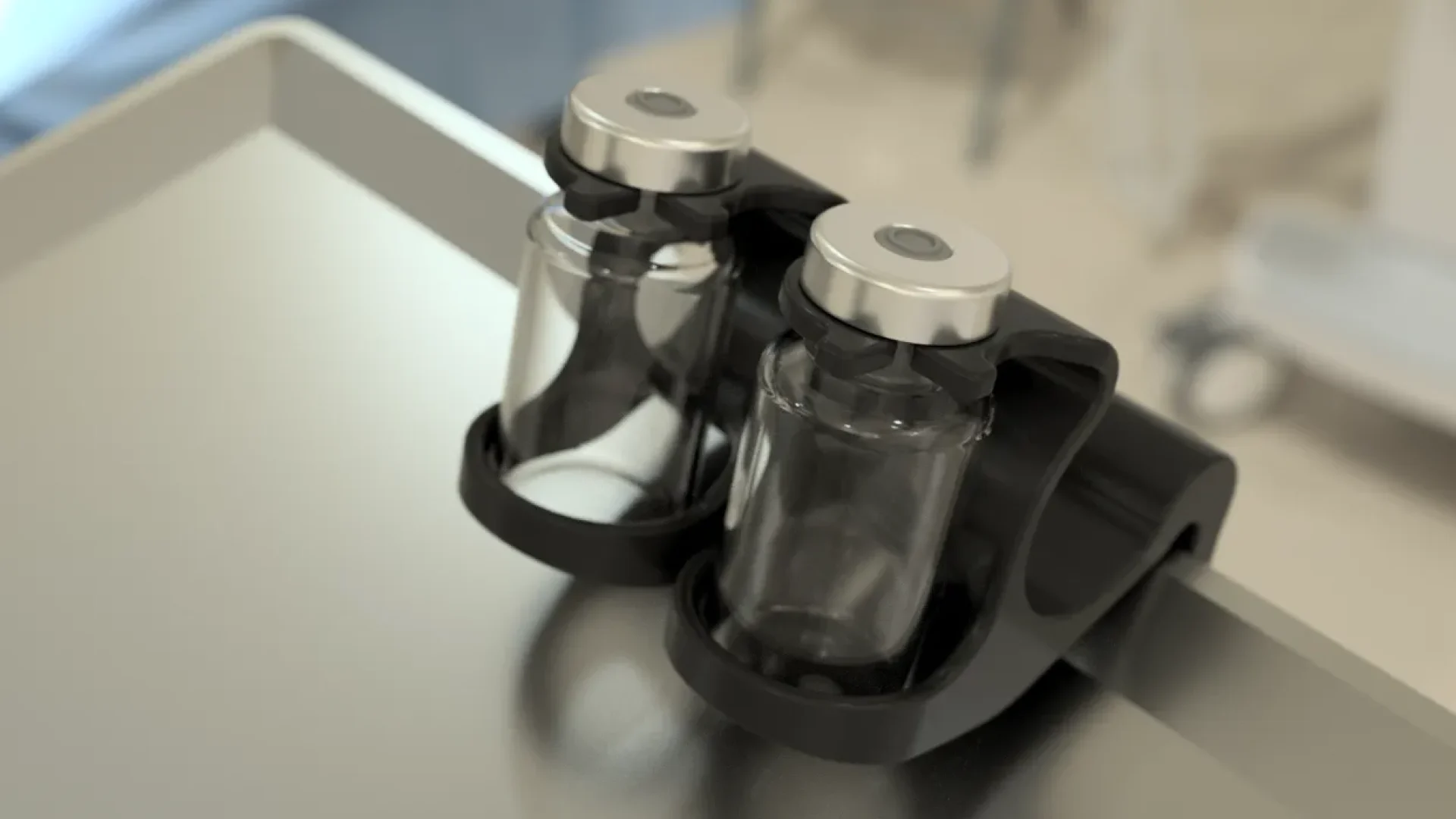
Walk through any working pharma or diagnostics lab and you will find a remarkable amount of improvised hardware. Racks held together with cable ties because the right holder does not exist in the right dimensions. Vial inserts from a desktop printer that someone on the team ran overnight. Custom brackets sourced from a local metalworker. These workarounds exist because the standard catalogue does not cover every configuration—and furthermore, ordering custom lab consumables through conventional manufacturing, with tooling costs, minimum order quantities, and weeks of lead time, is simply not practical for small quantities.
As a result, on-demand manufacturing with no minimum order quantities offers a fundamentally different approach. A custom vial holder, sample rack, tube guide, or gripper adapter can therefore be produced in small quantities, with the right material and tolerances, within days. For process development teams that iterate quickly, or lab operations teams that need to standardise equipment across multiple benches, that changes things considerably.
Common custom lab consumables requests we see
| Component type | Typical challenge | Why on-demand manufacturing helps |
|---|---|---|
| Vial and flask holders | Standard sizes don’t match specific vessel geometry or robot gripper clearance | Custom geometry to exact spec, small quantities, fast turnaround |
| Sample racks and tube guides | Instrument-specific configurations rarely available as catalogue items | Designed to fit the exact instrument, produced in the quantity needed |
| Gripper fingers and end-effector parts | Robot integrations often require custom contact geometry | Iterative design possible without tooling investment |
| Lab bench fixtures and mounting brackets | Standard brackets don’t account for specific layouts or load requirements | Produced in metal or polymer depending on the application |
| Spare parts for legacy instruments | Discontinued by the OEM, no aftermarket source available | Reproduced from a physical part or existing CAD file on demand |
Need custom lab consumables that does not exist in any catalogue?
We produce holders, racks, fixtures, and brackets on demand—in polymer and metal, with short European lead times and no minimum order.Lab automation and the hardware gap
Automation is moving fast—the supply chain for custom lab consumables is not
Lab automation was one of the dominant themes at Future Labs Basel—liquid handling robots, automated sample processing, connected instrument platforms. Integration costs have come down significantly in recent years, which means automation is now a realistic option for mid-sized labs, not just large pharma production environments. Nevertheless, a hardware gap exists that the automation vendors rarely address directly.
Every automated system needs physical infrastructure around it: the right racks, the right holders, the right guides and adapters to move samples reliably from one step to the next. When a lab integrates a new robot or reconfigures an existing line, those components often need to be custom. Moreover, “custom” in the traditional sense means weeks of lead time and order quantities that make no economic sense for a lab buying three or five pieces. Consequently, automation projects stall not because of the software or the robot—but because the right piece of custom lab consumables is not available in time.
This is precisely where 3D printing for pharma and lab environments slots in naturally—not as the automation technology itself, but as the flexible layer that makes automation work in a specific lab context. The robot is standard. The holder that positions the vials exactly where the gripper needs them is not. Getting that holder right, quickly and without a large minimum order, is often what determines how fast an integration actually moves.
What 3D printing in pharma actually delivers
There is no shortage of hype around 3D printing in life sciences. In reality, however, the picture is more specific: additive manufacturing is well-suited to a clear set of pharma and lab applications, and not particularly suited to others. According to FDA guidance on additive manufacturing, process validation and material traceability are the key requirements for regulated applications—which is why technology selection and supplier qualification matter more than the technology itself.
Where 3D printing in pharma makes clear sense
Custom lab consumables in small quantities—holders, racks, fixtures, guides, adapters—is the strongest fit. The geometry can be exactly right for the application, there is no tooling cost, and quantities of one to fifty are fully economical. For polymer parts, SLS and MJF deliver consistent mechanical properties and surface quality that work well in most lab settings. Additionally, prototyping and iteration during process development is a natural use case: a team can go from a revised design to a physical part in two or three days, without a minimum order sitting unused. Beyond custom components, 3D printing in pharma also covers spare parts for legacy instruments no longer available from the OEM—provided a validated digital file can be created.
Where conventional manufacturing is still the better answer
High-volume standard components, parts with very tight tolerances requiring significant post-processing, and anything where surface finish or sterility requirements exceed what polymer additive manufacturing supports—in these cases, CNC machining or injection moulding will usually be the right choice. Therefore, a supplier that handles multiple technologies and gives a clear recommendation on which process fits which part is considerably more useful than one that defaults to a single answer. The honest position on 3D printing in pharma is: it covers a significant share of custom component needs, but not all of them.
How Replique fits into this
Replique is a digital manufacturing platform that produces industrial parts on demand—including custom lab consumables, automation components, and spare parts for lab and production equipment. You bring the requirement (ideally a CAD file, though we can also help with design from scratch or reverse engineering from a physical part), we determine the right manufacturing process, and we produce the parts through our certified European partner network with full material and production documentation.
For teams dealing regularly with the kind of challenges that came up at Future Labs Basel—the slightly wrong catalogue part, the automation integration that needs a custom adapter, or the spare part no longer available from the OEM—on-demand manufacturing is worth evaluating seriously. Not as a replacement for standard procurement, but as the flexible layer that handles everything your regular supply chain cannot.
Want to see what is possible for your lab?
We assess your custom component needs and find the right manufacturing approach—3D printing, CNC, or a combination.FAQ
Can Replique produce parts without an existing CAD file?
Yes. For parts where no CAD file exists—for example, a discontinued spare part or a component originally made in-house—we can work from physical samples, drawings, or technical descriptions to create a production-ready digital file. The effort depends on part complexity, and we are happy to assess a specific requirement upfront.
Is 3D printing in pharma environments mature enough for production use?
For the right applications, yes. Industrial processes like SLS and MJF produce parts with consistent mechanical properties, traceable material quality, and the documentation that regulated environments require. The key is selecting the right technology for the right part—3D printing in pharma works extremely well for custom lab consumables, fixtures, and low-volume spare parts, but is not always the right answer for high-volume or sterile-contact components.
Materials and lead times
What materials are available for custom lab consumables?
For polymer parts, we work with a broad range of engineering materials including PA12, PA11, PP, and various filled grades. Selection depends on mechanical requirements, chemical exposure, and temperature range. For metal components, stainless steel, aluminium, and titanium are available depending on the process. For applications with specific chemical resistance or sterilisation requirements, material selection is worth discussing early.
What is the minimum order quantity?
There is no minimum order quantity for 3D printed parts. Single-unit production is fully economical for additive manufacturing, which is exactly what makes it useful for custom lab consumables and low-volume requirements. For CNC-machined components, small batches of five to ten pieces are generally feasible depending on part complexity.
How quickly can custom lab parts be delivered?
For polymer parts via SLS or MJF, typically three to seven business days from a validated CAD file to delivery within Europe. For machined metal parts, generally seven to fifteen business days. Express options exist for qualifying requirements—worth discussing directly if timing is critical.