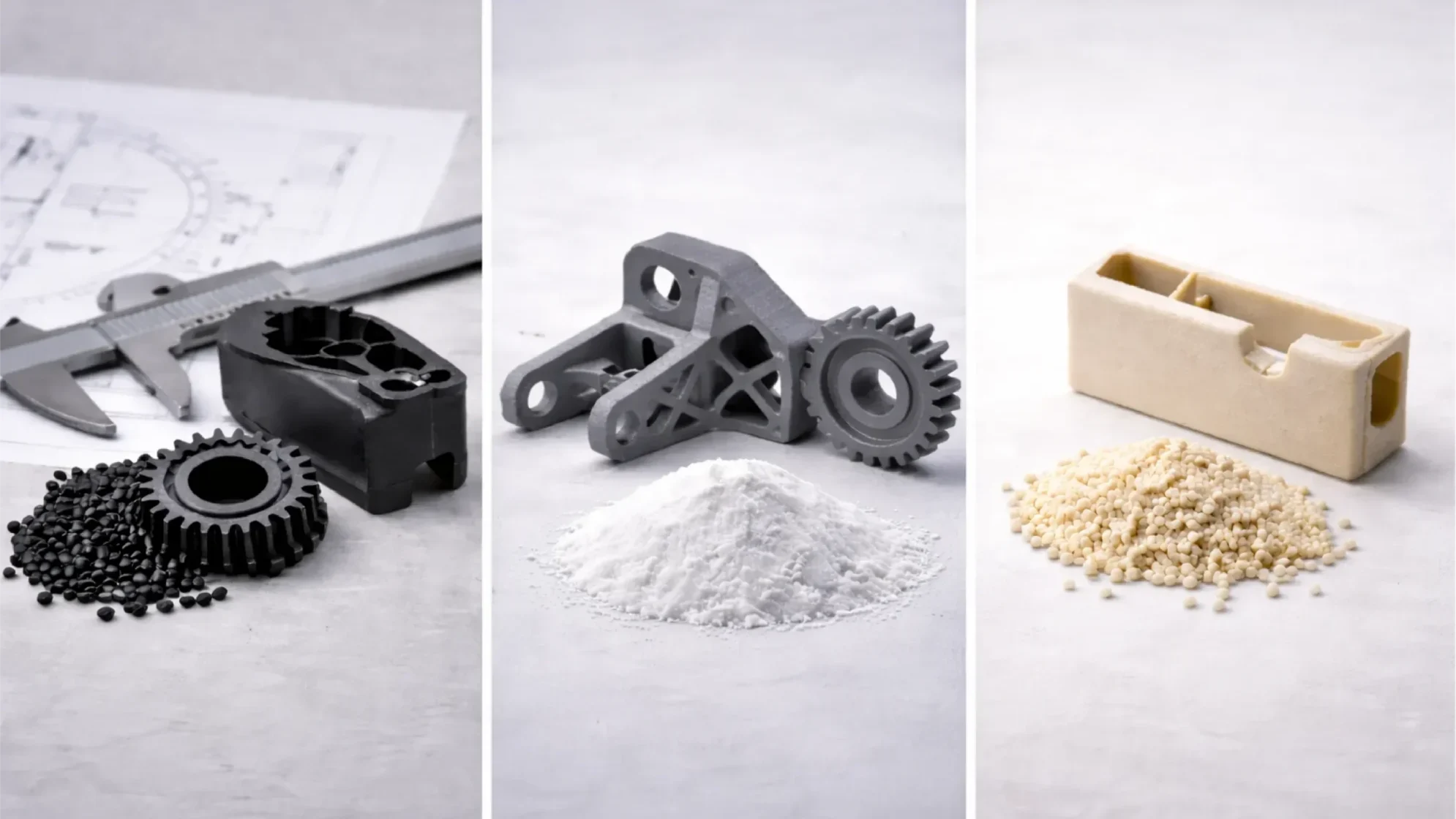
PA12, PA11 and PA6 are among the most important polyamides used in industrial manufacturing. They are commonly found in 3D printing, injection moulding, CNC machining and extrusion—often in similar-looking applications, but with clearly different performance profiles.
That is exactly why the question “PA12 vs. PA11 vs. PA6—which polyamide is the right choice?” matters so much in practice. The answer depends on more than tensile strength alone. Moisture absorption, stiffness, toughness, chemical resistance, process compatibility and sustainability requirements all play a role.
For engineers, designers and R&D teams, comparing polyamides based on a single datasheet value often misses the real decision criteria in actual use.
Choosing the right material rarely comes down to one number. In most cases, it is the combination of part function, environment, manufacturing process and tolerance requirements that drives the right decision.
This guide compares PA12, PA11 and PA6 in a structured, practical way—covering key properties, process fit and a clear selection framework for engineering applications.
At a glance: when to choose PA6, PA12 or PA11
As a first technical shortcut, material selection often comes down to three common use cases:
Best when high stiffness, strength and cost-efficiency matter—and moisture is not a critical factor.
Best when functional parts are produced via 3D printing and low moisture uptake plus dimensional stability are important.
Best when properties similar to PA12 are needed, but a bio-based material is also a priority.
What do the numbers in PA6, PA11 and PA12 mean?
The numbers in polyamide names refer to the number of carbon atoms in the polymer building blocks.
- PA6 is produced from caprolactam.
- PA11 is based on 11-aminoundecanoic acid and is typically derived from castor oil.
- PA12 is synthesised from laurin lactam.
These structural differences directly affect material performance. In practice, longer hydrocarbon chains generally tend to reduce moisture uptake and improve chemical resistance. At the same time, stiffness, strength and process behaviour vary depending on the polymer type and moisture condition.
For polyamides, conditioning matters. Many mechanical properties differ significantly between dry-as-moulded and moisture-equilibrated states.
PA12 vs. PA11 vs. PA6: property comparison
The table below shows typical reference values for unfilled grades. Actual values can vary depending on supplier, compound formulation, additives and manufacturing process.
| Property | PA6 | PA12 | PA11 | Unit / Standard |
|---|---|---|---|---|
| Tensile strength (dry) | 75–85 | 45–55 | 50–55 | MPa / ISO 527 |
| Tensile strength (moisture equilibrium) | 40–55 | 40–48 | 42–50 | MPa / ISO 527 |
| Elongation at break (dry) | 30–50 | 100–200 | 150–300 | % / ISO 527 |
| Young’s modulus (dry) | 2800–3300 | 1400–1700 | 1300–1600 | MPa / ISO 527 |
| Impact strength (unnotched, 23 °C) | 50–100 | 130–180 | 120–160 | kJ/m² / ISO 179 |
| Heat deflection temperature (HDT A) | 60–65 | 50–60 | 48–58 | °C / ISO 75 |
| Continuous use temperature | 80–100 | 90–110 | 90–110 | °C |
| Moisture absorption (23 °C, saturation) | 8–9 | 1.5–2.0 | 1.8–2.2 | % / ISO 62 |
| Density | 1.12–1.14 | 1.01–1.03 | 1.02–1.04 | g/cm³ |
| Chemical resistance to oils/fats | good | very good | very good | – |
| Chemical resistance to diluted acids | moderate | good | good | – |
| UV resistance | moderate | good (stabilised) | good (stabilised) | – |
| Renewable feedstock | no | no | yes | – |
| Typical raw material cost | approx. 2–3 | approx. 7–11 | approx. 8–13 | €/kg, indicative |
The basic pattern is clear: PA6 is stiffer and stronger, while PA12 and PA11 are significantly tougher and absorb far less moisture. That is what ultimately defines their typical application profiles.
PA6 in detail: high strength and stiffness—with clear limits in humid environments
PA6 is a classic engineering plastic when stiffness, strength and cost-efficiency are the top priorities. In its dry state, PA6 typically offers the highest tensile strength and modulus of the three polyamides compared here.
That makes it especially attractive for mechanically loaded parts where rigidity matters and the service environment remains relatively controlled.
Where PA6 performs particularly well
- Injection-moulded parts in medium to high production volumes
- Mechanically loaded components used in dry indoor environments
- CNC-machined semi-finished parts where stiffness is important
- Cost-sensitive applications using established manufacturing routes
The key limitation: moisture absorption
PA6’s main weakness is its relatively high moisture uptake. In humid environments, the material can change noticeably in terms of dimensions, stiffness and strength. For precision components with tight tolerances, this can become a critical design factor.
PA6 is not inherently a poor material for humid environments, but it is much more sensitive to moisture than PA12 or PA11. For fits, precision parts and variable operating conditions, this should be considered early in the selection process.
PA12 in detail: the benchmark material for technical 3D printing
PA12 is the established standard material for SLS and MJF. That is not only because of its mechanical performance, but also because of its excellent process stability. In powder-based additive manufacturing, PA12 is known for reliable processing and consistent part quality.
Compared to PA6, PA12 is less stiff but tougher and far less sensitive to moisture. That makes it a strong all-round choice for many functional parts.
Why PA12 matters so much in practice
- Low moisture absorption and good dimensional stability
- Excellent fit for SLS and MJF
- Broad availability across industrial 3D printing platforms
- Proven material for end-use parts, small batches and spare parts
For many companies, PA12 is the default choice when functional polymer parts are produced additively—especially when moisture exposure, dimensional stability and process reliability are important.
Not sure which material fits best?
A quick feasibility check can help identify whether PA12, PA11 or PA6 makes the most sense for your part.PA11 in detail: bio-based polyamide with high toughness
PA11 is often seen as a material that sits close to PA12 in performance. The main difference lies in its feedstock: PA11 is typically derived from castor oil, making it a bio-based polyamide.
Mechanically, PA11 is often characterised by high elongation at break and strong impact resistance. That makes it particularly interesting when material selection needs to balance technical performance with sustainability goals, material strategy or ESG considerations.
When PA11 is especially interesting
- When a bio-based engineering material is preferred
- When toughness and flexibility matter more than maximum stiffness
- When an alternative to PA12 is being considered
- When sustainability and performance need to be evaluated together
In industrial 3D printing, PA11 is becoming increasingly available, although it is still less broadly established than PA12. Even so, it can be a strategically attractive material in the right application context.
Manufacturing process comparison: which polyamide fits which route?
The right material choice depends not only on properties, but also on how the part will be manufactured.
| Manufacturing process | PA6 | PA12 | PA11 |
|---|---|---|---|
| SLS (Selective Laser Sintering) | not standard | excellent / standard | increasingly available |
| MJF (Multi Jet Fusion) | not standard | excellent / standard | limited |
| Injection moulding | excellent / standard | good | good |
| FDM / filament printing | limited | good | available |
| CNC machining | good | good | good |
| Extrusion | excellent | good | good |
In practical terms, this means: PA6 often dominates in injection moulding, PA12 remains the standard for technical 3D printing, and PA11 becomes attractive when bio-based materials or higher toughness are part of the decision.
Selection guide: when to choose which polyamide
In practice, material selection often comes down to a few key questions:
PA6 is usually the better fit when …
high stiffness and strength are required, the application environment is relatively dry, injection moulding or machining is planned, and cost is a major consideration.
PA12 is usually the better fit when …
SLS or MJF is the intended process, moisture resistance and dimensional stability are important, and a robust all-round material is needed for functional polymer parts.
PA11 is usually the better fit when …
a material with a profile similar to PA12 is needed, but bio-based feedstock, ESG goals or especially high toughness are also part of the decision.
Conclusion: PA12, PA11 or PA6?
PA6, PA12 and PA11 are not interchangeable choices. Each material addresses a different engineering requirement profile.
- PA6 stands out for stiffness, strength and cost-efficiency—but with clear limitations in humid environments.
- PA12 is the strong all-rounder for technical 3D printing, combining low moisture uptake with broad application potential.
- PA11 offers many of the same technical advantages as PA12, with the added benefit of a bio-based raw material source.
In practice, the best material decision rarely comes from one property alone. It comes from the combination of part function, operating environment, tolerance requirements, manufacturing route and broader material strategy.
Looking at a specific part?
Replique supports material selection and helps identify the most suitable manufacturing technology for your application.FAQ – PA12 vs. PA11 vs. PA6
Which polyamide is best for SLS and MJF?
In industrial practice, PA12 is the standard material for both SLS and MJF. PA11 is also available, but it is not equally established across all machines and process environments.
Which polyamide performs better in humid environments?
For humid or fluctuating environments, PA12 and PA11 are generally more favourable than PA6 because they absorb much less moisture and therefore maintain dimensional stability more effectively.
Is PA11 biodegradable?
No. PA11 is typically bio-based, but it is not biodegradable. Even so, it can still be relevant in ESG-driven material strategies and procurement decisions.
Can a PA6 injection-moulded part be directly replaced by a PA12 SLS part?
In many cases, yes—but not automatically on a one-to-one basis. Geometry, wall thickness, tolerances and mechanical requirements should always be checked individually.
What do glass or carbon fibres change in polyamides?
Fibre-reinforced compounds typically increase stiffness, strength and heat resistance, but often reduce elongation at break and impact toughness. They also make the final performance more process-dependent.