CNC vs. 3D printing is one of the most debated questions in modern manufacturing — and one of the most frequently misanswered. The truth is uncomfortable for both camps: CNC machining is not outdated. Additive manufacturing is not a cure-all. Both technologies have clearly defined strengths, weaknesses, and use cases. This article provides a technical, no-nonsense comparison based on measurable performance metrics.
- Fundamental Differences: Subtractive vs. Additive
- Tolerances: What Is Technically Realistic?
- Material Properties: Isotropic vs. Anisotropic
- Cost Structure: Fixed vs. Variable
- Material Range: Who Has More Options?
- When CNC, When AM? The Decision Matrix
- The Hybrid Approach: AM Meets CNC
- Conclusion
- FAQ
The “CNC or 3D printing?” debate is often framed as if there has to be one clear winner. In practice, that is almost always the wrong question. The winning technology is not the one that sounds more innovative, but the one that meets the requirements of a specific part in the most economical way.
A proper comparison has to focus on measurable criteria: tolerances, surface finish, material behavior, batch size, complexity, post-processing, lead time, and risk. Only by combining those factors can you reach a reliable decision.
The most common mistake in technology comparisons is not choosing the wrong manufacturing process — it is assuming that one single process should be optimal for every part.
Fundamental Differences: Subtractive vs. Additive
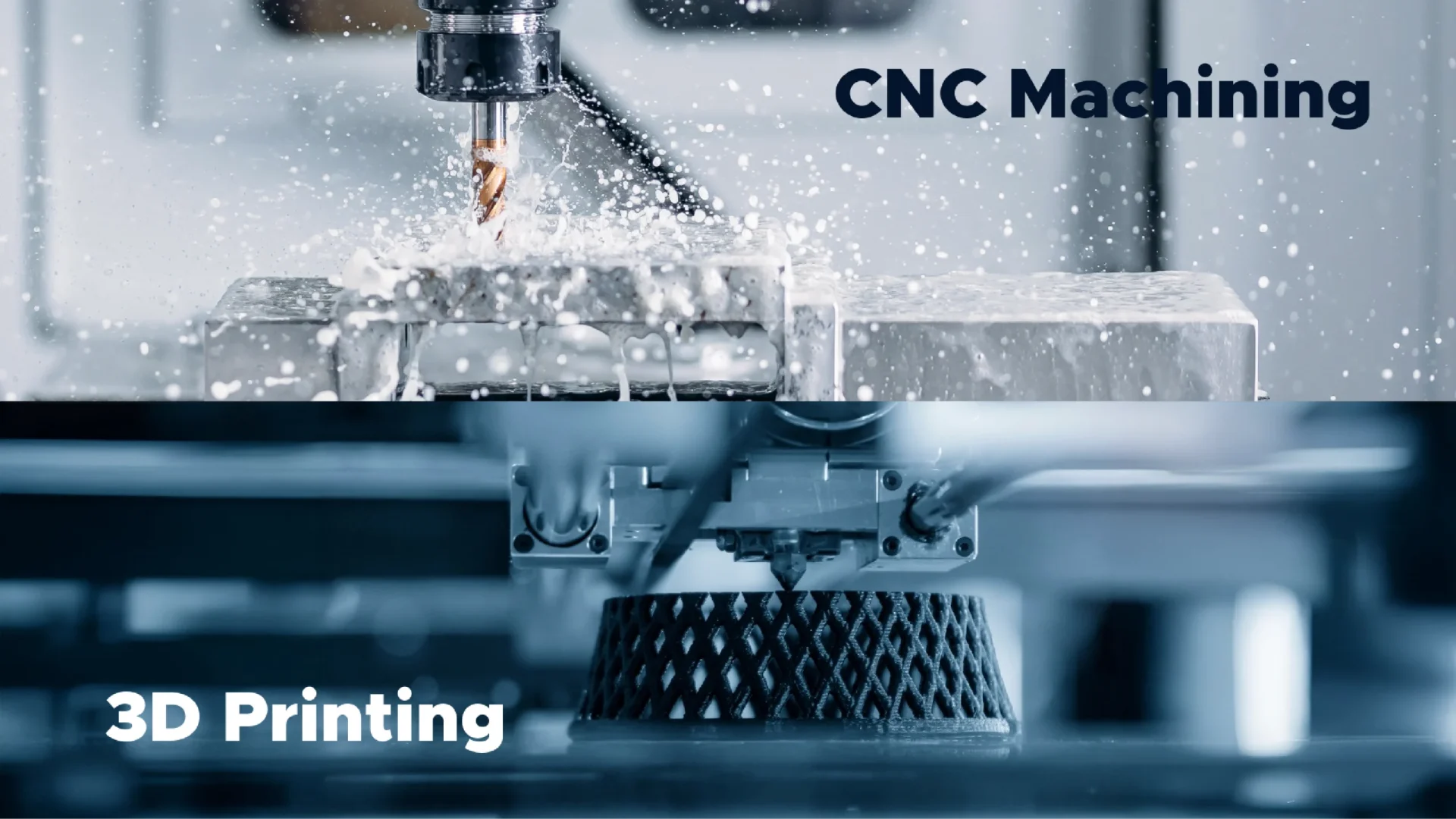
CNC machining is a subtractive process: material is removed from a solid workpiece — through milling, turning, drilling, or EDM, for example — until the desired geometry is achieved. The result is a homogeneous, isotropic part made from the original stock material, meaning it retains the same material properties in every direction.
Additive manufacturing works in exactly the opposite way: the part is built up layer by layer. SLS and MJF fuse powder particles, FDM extrudes thermoplastic filament, and DMLS melts metal powder with a laser. The result is a part whose mechanical properties can differ along the build axis compared to across it. This effect is known as anisotropy and is more or less pronounced depending on the process and material.
Subtractive
Material is removed. The part behaves like the original stock material. Key strengths are precision, surface finish, and isotropic material behavior.
Additive
Material is built up layer by layer. Design freedom and low complexity-related cost are major advantages, but anisotropic behavior has to be accounted for in the design.
Tolerances: What Is Technically Realistic?
Tolerances are the most common point of confusion in process comparisons. AM is often overestimated, while CNC is frequently specified far more tightly than the application actually requires. What matters are realistic values from practical production — not idealized numbers from marketing slides.
| Process | Typical Tolerance | Best Achievable Result | Surface Finish Ra | Key Influencing Factors |
|---|---|---|---|---|
| CNC Milling | ±0.02–0.05 mm | ±0.005 mm | 0.8–3.2 µm | Material, tool, temperature |
| CNC Turning | ±0.01–0.05 mm | ±0.003 mm | 0.4–1.6 µm | Runout, tool |
| EDM (Wire) | ±0.002–0.005 mm | ±0.001 mm | 0.1–0.4 µm | Dielectric, voltage |
| SLS (PA12) | ±0.2–0.3 mm | ±0.1 mm | 8–15 µm | Shrinkage, build volume |
| MJF (PA12) | ±0.2–0.3 mm | ±0.1 mm | 6–12 µm | Shrinkage, part size |
| FDM | ±0.3–0.5 mm | ±0.2 mm | 12–25 µm | Layer height, orientation |
| DMLS (316L) | ±0.1–0.15 mm | ±0.05 mm | 6–15 µm | Residual stresses, post-processing |
| Injection Molding | ±0.05–0.15 mm | ±0.03 mm | 0.5–2.0 µm | Tooling, material, cycle |
Important: These values apply to parts straight out of the process. With post-processing, AM parts can be improved significantly. On the other hand, overly tight CNC tolerances often create unnecessary cost when the application does not actually require them.
Grinding, polishing, or electropolishing can improve the dimensional accuracy and surface quality of additive parts. But that does not change the basic conclusion: if an application needs to stay reliably below ±0.1 mm or requires very fine functional surfaces, CNC has the technical advantage.
Material Properties: Isotropic vs. Anisotropic
CNC: Homogeneous Material Properties
With CNC parts, the mechanical properties are those of the starting material. A CNC-milled part made from aluminum 6061-T6 has the same tensile strength, yield strength, and elongation at break in every direction. That makes CNC parts especially reliable for dynamically loaded components, tight fits, and applications where failure behavior has to be predictable and repeatable.
AM: Anisotropy as a Critical Factor
With additively manufactured parts, mechanical properties depend on the build direction. SLS parts made from PA12 usually show only moderate anisotropy. With FDM, the effect is much more pronounced: strength in the Z-direction is often only 50–70% of the XY-direction. DMLS metal parts can approach conventional material values after heat treatment or HIP, but they remain strongly process-dependent.
The practical takeaway for engineers: with AM parts, build orientation is not just a production detail — it is a design parameter.
Cost Structure: Fixed vs. Variable
The cost model is often more important than the technology question itself. CNC does not have traditional tooling costs like injection molding, but it does have high variable costs that scale strongly with machining time, tool accessibility, and complexity. A simple turned aluminum part can be very cost-effective. A part with many pockets, holes, and hard-to-reach features, on the other hand, becomes expensive very quickly.
Additive manufacturing also avoids tooling costs, but its cost scales more with material volume and build volume utilization than with geometric complexity. A complex undercut costs little more in SLS than a simple shape — whereas on a CNC machine, that same geometry may require many times more machining effort.
The rule of thumb is therefore simple: as geometric complexity increases, the decision shifts more toward AM. As tolerance, surface finish, or the need for isotropic strength increases, it shifts more toward CNC.
Material Range: Who Has More Options?
CNC can process almost any solid material: aluminum, steel, titanium, brass, copper, as well as high-performance plastics such as PEEK, POM, PTFE, and nylon. Nearly anything available as bar stock, plate, or block can in principle be machined.
AM offers a fast-growing but still narrower material space. Typical polymers include PA12, PA11, TPU, PP, and glass-filled variants. In metals, the most common materials are 316L, 17-4 PH, AlSi10Mg, Ti-6Al-4V, Inconel 718/625, and certain copper alloys. For many specialty materials, CNC remains the more flexible option today.
- CNC preferred for exotic or highly specific materials available as standard stock
- AM preferred for geometries that benefit from material savings, internal channels, or lightweight design
- Hybrid makes sense when both complex geometry and highly precise functional surfaces are required
When CNC, When AM? The Decision Matrix
| Requirement | CNC Preferred | AM Preferred | Hybrid Makes Sense |
|---|---|---|---|
| Tolerance < ±0.1 mm | Yes | No, not without post-processing | AM near-net shape + CNC finishing |
| Complex geometry / undercuts | Time-consuming and expensive | Yes, with little to no complexity surcharge | Less common |
| Batch size 1–50 | Possible | Often economical | Depends on the part |
| Batch size 500+ | Yes, scales well | Often expensive | Consider injection molding |
| Material: titanium / Inconel | Yes | Yes, via DMLS | AM near-net shape + CNC |
| Isotropic strength required | Yes | Only to a limited degree or after post-treatment | DMLS + heat treatment |
| Ra < 1 µm | Yes | Only with post-processing | AM + polishing / grinding |
| Urgent lead time, 1–3 days | Good for simple parts | Good for polymer parts and complex geometries | Depends on the application |
| High IP sensitivity | Both possible | Both possible | Platform and process protection matter most |
The Hybrid Approach: AM Meets CNC
For demanding applications, hybrid manufacturing is becoming increasingly common: the part is produced by AM in a near-net shape to enable complex internal geometries, lattice structures, or material savings. Critical functional surfaces such as fits, sealing faces, or mounting holes are then machined to final dimensions with CNC.
Typical Hybrid Applications
Titanium Ti-6Al-4V turbine blades with an additively produced near-net shape and CNC-finished functional surfaces.
Medical implants with an additively produced base geometry and machined seating or contact surfaces.
Hydraulic blocks with internal channels, where threads, connection faces, and sealing surfaces are machined afterward.
This is exactly where it becomes clear that the real question is not “CNC or AM?” but often “How do you combine both technologies intelligently?”. For parts with complex geometry and tight functional requirements, a hybrid strategy is often the technically cleanest solution.
Not sure which technology is right for your part?
A technical comparison based on geometry, tolerance, material, and batch size usually reveals the most economical route very quickly.Conclusion: No Single Winner — Only the Right Technology for the Application
The question “CNC or 3D printing?” is too broad. The better question is: which technology meets the specific requirements of this part in the most economical way? In many cases, the answer is CNC. For complex geometries, small production runs, and rapid prototyping, AM often has the edge.
In a multi-technology manufacturing world, the real advantage does not come from choosing the louder technology — it comes from making a decision that aligns tolerance, material, geometry, risk, and cost in the smartest possible way.
FAQ: Frequently Asked Questions
Can AM parts achieve the same surface finish as CNC parts?
Not in their as-built state. SLS and MJF parts typically have much rougher surfaces than CNC parts. However, tumbling, polishing, sealing, or electropolishing can significantly improve additive parts — in some cases bringing them close to CNC-level finish.
Are AM metal parts as strong as CNC-machined metal parts?
That depends heavily on the process and post-treatment. DMLS parts can come very close to conventional material values after heat treatment and HIP. Without a proper process chain, though, differences in porosity, surface condition, and fatigue performance remain important.
When is a 5-axis CNC machining center worth it compared to 3-axis milling?
Mainly for complex freeform surfaces, deep cavities, and highly precise parts where multiple setups would otherwise lead to tolerance stack-up. For simple prismatic geometries, 3-axis machining is often sufficient and more cost-effective.
Which AM processes are suitable for metal parts in safety-critical applications?
DMLS/SLM and EBM are the most relevant processes. With process qualification, heat treatment, and HIP, these methods can achieve properties suitable for demanding industries such as aerospace, medical, or oil and gas. Binder jetting is usually not the first choice for those applications yet.
Can I use the same CAD file for CNC and AM?
Technically yes, but economically it is often not ideal. CNC benefits from DfM-oriented geometry, while AM benefits from DfAM. A single model may be usable for both processes, but in most cases you leave performance and cost savings on the table if the design is not tailored to the chosen technology.